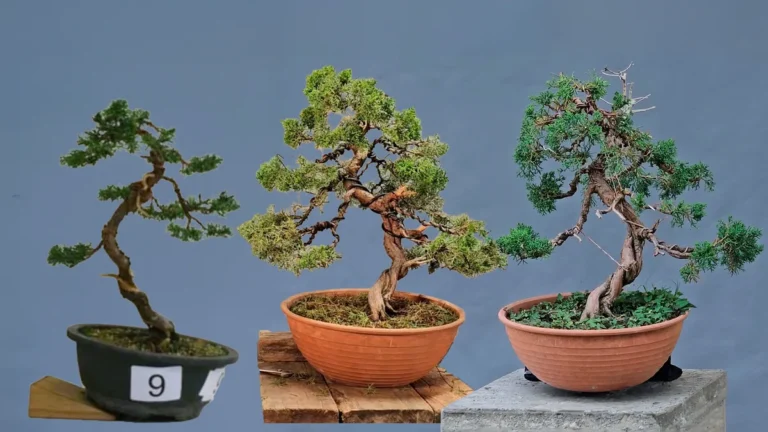
In a twin trunk bonsai — known in Japanese tradition as sokan — the secondary stem, often called “the son”, is supposed to be thinner and shorter than the primary one, often called the father. This is easier said than done, though, as cultivating a twin trunk pre-bonsai often requires a lot of attention in keeping the young, vigorous son from outgrowing the older, oftentimes more mature and ramified father. If you do not intervene at the right moment, more energy will flow to the thinner trunk and you will risk finding yourself dealing with a slingshot-style bonsai…
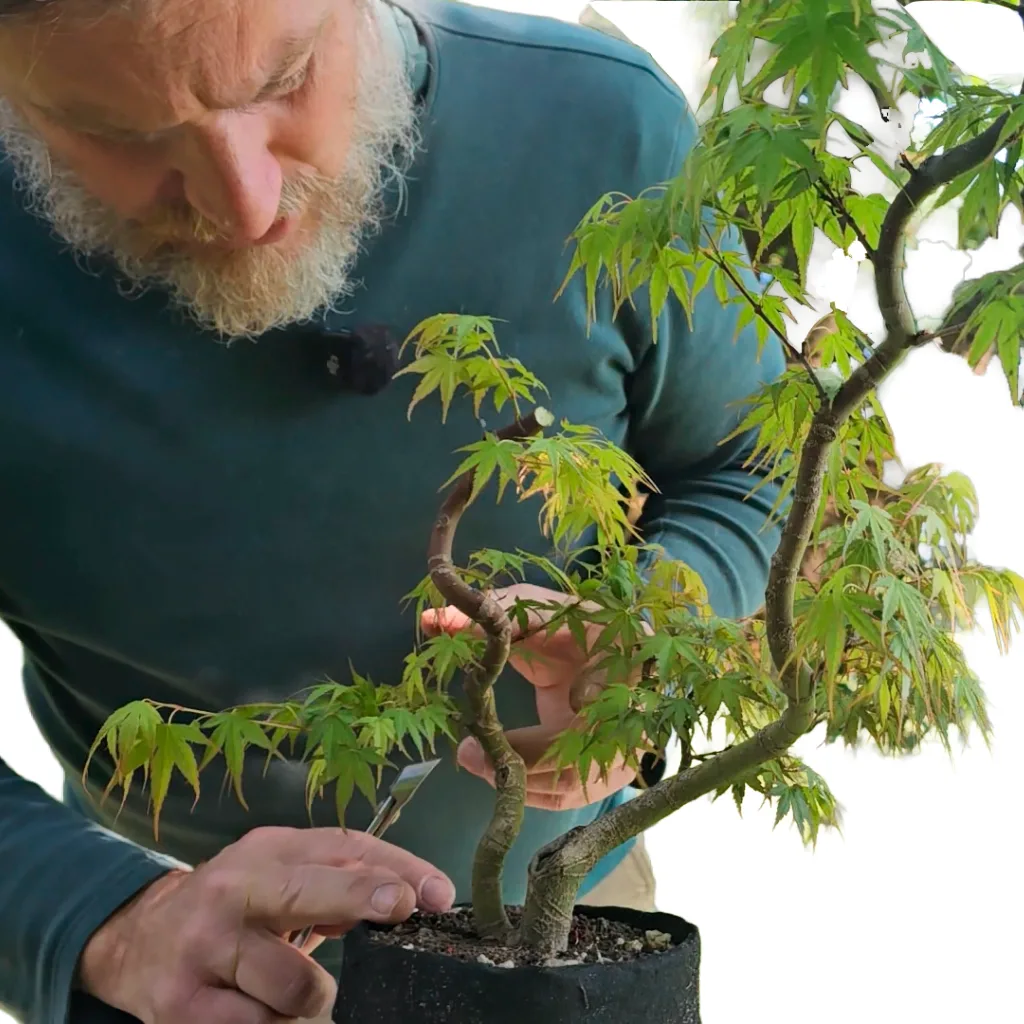
This article walks through the exact sequence Luca uses on an Acer palmatum pre-bonsai: how to read the tree, where to direct energy, which branches to keep and which to remove, and how to change the apex on the son trunk without leaving scars. The technique is simple. The timing is everything.
Enjoying this tutorial? Subscribe to our YouTube channel for weekly bonsai content →
Why the Son Trunk Outgrows the Father
In the wild, the “son” trunk is thinner than the father as it is much younger and receives less sun and resources as it is partially shadowed by the taller father. In a bonsai pot, both trunks are roughly receiving the same amount of resources and trunk thickness can rapidly increase if a sacrificial branch is allowed to run.
Reading the Tree After Spring Repotting
The window opens immediately after the spring repotting. The plant is recovering, pushing energy into every active growing tip. This is the moment you decide who grows and who waits. Look for three signals before you cut anything:
- Active apices — which tips are already extending? Those are the ones consuming the most energy right now.
- Internode length — long internodes mean the plant is running. Short internodes mean it has slowed down naturally and the wood is consolidating.
- Trunk thickness ratio — compare the diameter of the father at the split to the diameter of the son at the same height. The father should be visibly thicker. If it is not, you have work to do.
The choice of front matters too. Pick the angle that puts the father in the foreground and the son slightly behind, or viceversa. In general, aligning the two (one hiding the other or both at the same distance from the observer) looks a bit unnatural and artificial. A small lean of the pot toward the front often helps the composition, too, and it tells you which side of each trunk needs to fill out.
Containing the Son: Branch Selection and Contouring
Start at the base of the son and work upward. The job is to keep the branches that build the future silhouette and remove the ones that will only create scars or competition. A few rules of thumb:
- Two branches at the same height create a T-junction and an inverse taper. Keep one, remove the other — preferably the one that grows inside the curve.
- Internal branches on a curve almost always go. They never become structural and they steal light from the outer branches that will.
- Vertical shoots on a branch that should be horizontal need to be cut back to a lateral bud. Wait too long and the vertical thickens enough to leave a visible scar when you finally cut it.
- Duplicates of branches you already have — if the son already has a branch heading into depth at one height, the next one above that does the same thing is redundant. Pick the better-positioned one.
Pay particular attention to depth branches. In the video, Luca identifies a branch on the son that grows into depth but has shot up too vertically. Rather than removing it entirely, he cuts back the vertical section and selects a horizontal lateral shoot lower down — then wires it to direct growth into the depth of the composition. This selective redirection preserves the branch’s purpose while correcting its trajectory.
Cuts on the son should be tight against the trunk, made cleanly with a sharp tool. Removing branches early — when they are still thin — is what prevents the scars that ruin a trunk five years later.
Single-Apex Strategy: Letting the Father Trunk Thicken
To thicken the father trunk, you need one strong, unchallenged apex pulling sap upward. Acer palmatum seedlings produce many candidate shoots at the top, and the temptation is to keep several to give the tree options. Resist that temptation. Multiple apices split the energy. One single dominant apex thickens the trunk fastest and helps existing wounds callus over.
Choose the most active, vertical, vigorous shoot. Then cut every competing shoot at the top — the sister buds beside the chosen one, the secondary apices on lateral branches, the small tips trying to extend horizontally at the very top of the tree. The rule is simple: anything competing with the chosen apex either gets removed or gets pinched short enough to stop being a competitor.
Lower branches on the father that already have the thickness you want should also have their leading shoots removed. They will continue to ramify, but they will stop bulking up. Energy that would have gone into bonsai trunk thickening on those branches now flows past them and up to the chosen apex. This is the core mechanism behind energy management in a sokan — controlling which apex pulls determines which trunk grows.
Before You Cut: Mistakes That Ruin a Sokan Long-Term
The two trunks in a sokan bonsai need opposite treatment. Once you understand the contrast, every cut becomes obvious.
Before applying any of the actions below, watch out for the cuts that quietly damage long-term results: pinching the leader of the father (which slows thickening), allowing internal shoots to compete for sap, and waiting too long after the spring push to act (small scars become permanent ones).
Changing the Apex on the Son Without Scarring
The son often needs an apex change, not just apex selection. Because the son has been running, its current top is too long, the internodes between the trunk and the new apex are exaggerated, and the shape lacks taper. The fix is to reach further back into the trunk and pick a smaller, well-placed shoot as the new apex.
If the son has been running too much and its current top is too long and with long internodes, the solution is an apex change. Down from the top, reach further back into the trunk and pick a smaller, well-placed shoot as the new apex.
Look for an active, short, well-oriented shoot with short internodes (at least the first one) and cut the old apex just above that shoot. If the apex is not actively growing, leave a small stub above it to avoid die back. Do not bend or wire the new apex immediately. Let it harden for a few weeks. When you see the chosen shoot start to extend actively, that is your signal that it has accepted the role. From that point, you can shape it to give the apex the movement the trunk needs, and shorten the stub further if it has not yet started to callus.
If the son has already elongated well beyond recovery, Luca notes a more radical option: air layering the upper section to create a new tree, then continuing to develop the lower portion with better proportions. This turns an overbuilt son into an asset rather than a liability.
Key Takeaways
- In a sokan (twin trunk) bonsai, the son almost always outgrows the father — it is structural, not accidental
- The decisive window is the weeks just after spring repotting, when energy is flowing and direction is still negotiable
- The father needs a single dominant apex to thicken; remove every competing shoot at the top
- The son needs containment: stop the leaders, prune internal branches, refine the silhouette
- Cut competing branches early, while they are thin, to prevent scars that ruin the trunk later
- Redirect depth branches by cutting vertical sections and wiring horizontal laterals into the composition
- An apex change on the son is often necessary — reach back into the trunk for a shorter, better-placed shoot
- Leave a small stub above a new apex; the plant closes the wound naturally as sap flows through
Frequently Asked Questions
Why does the son trunk grow thicker in a sokan bonsai?
In a sokan (twin trunk) bonsai, the son trunk runs ahead because it usually emerges as the more vertical, more vigorous branch at the point where the trunk splits. That vertical orientation captures more sap flow and triggers stronger apical dominance, which suppresses growth on the father. The imbalance is structural — it happens on almost every twin trunk seedling, especially vigorous species like Acer palmatum. The fix is to redirect energy by giving the father a single dominant apex while containing the son through selective pruning.
When is the right moment to prune a twin trunk Acer palmatum?
Immediately after the spring repotting, while the tree is pushing actively and you can clearly see which apices are leading. This is when the plant has the most flexibility to redirect energy and when small cuts produce the largest structural effect. A second opportunity comes in early summer once the first flush has hardened, but the spring window is where most of the work should happen.
Can I correct an unbalanced twin trunk that has already matured?
Partially. Once both trunks have lignified to their current diameters, you cannot easily make the father catch up to the son. What you can do is contain the son aggressively — stop its apex, remove its leaders, and force it to ramify rather than thicken — while letting the father run with a single dominant apex for several seasons. Over time the gap narrows, and a sacrificial branch low on the father can accelerate the process if the trunk geometry allows it.
How aggressive should I be when cutting back the son trunk?
More aggressive than feels comfortable, especially if the son has already overshot. Reach back to the shortest viable internode that still has an active, well-positioned shoot, and accept that you may be removing several centimetres of growth. Smaller cuts now, even if they look severe, are always better than larger cuts later — the wound closes faster, the scar stays smaller, and the new apex consolidates within a single season.
What is the difference between an apex change and apex selection?
Apex selection is choosing which of several existing top shoots becomes the leader, and removing the rest — you keep the current height. An apex change moves the apex itself: you cut back the trunk to a shorter shoot below the previous top, accepting a lower height in exchange for better taper and shorter internodes. The son trunk usually needs an apex change. The father, since you want it to keep extending, only needs apex selection.