
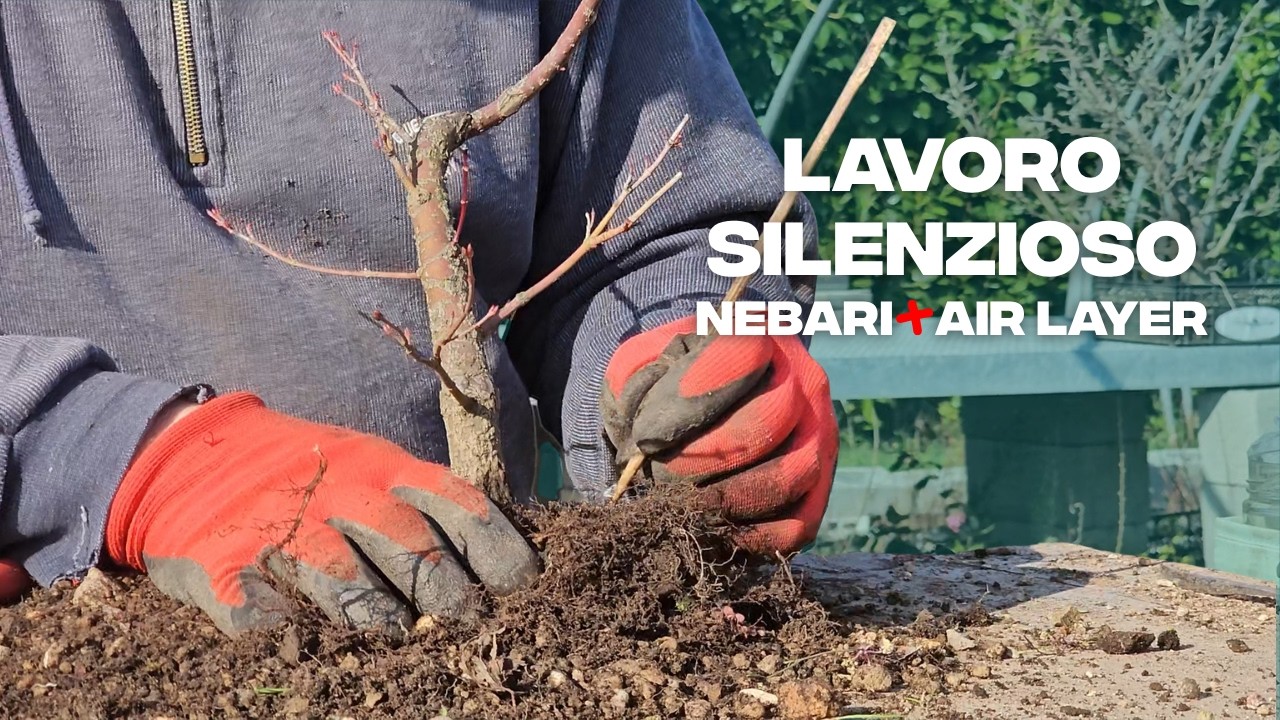
Air Layering Bonsai: How to Get Perfect Nebari in Weeks
Air layering is one of the most underused techniques in bonsai — and one of the most powerful. Unlike cuttings, it gives you something that usually takes years to build: a radial nebari from day one.
In this video, Luca demonstrates a complete air layering session on a variegated Acer palmatum, and opens three air layers made the previous autumn to reveal the results.
Enjoying this tutorial? Subscribe to our YouTube channel for weekly bonsai content →
Why Air Layering Instead of Cuttings?
Cuttings are fast and easy. But they come with a cost: roots that emerge at different heights along the trunk, uneven distribution, and an internodal section that needs to be buried — often hiding years of taper work underground.
Air layering forces the plant to produce roots exactly where you want them. Because you’re intercepting the descending sap flow at a precise point, the plant redirects its energy to form roots right at the incision. The result is a compact, radial root ball that becomes the nebari of your future bonsai — already positioned exactly where you want it.
The advantage is enormous: you skip three to five years of nebari development compared to starting from a cutting. If you’re working with quality young pre-bonsai material, this head start matters enormously.
When to Air Layer
Spring, just before the vegetative push, is the optimal window — but it’s not the only one. Luca’s approach is to air layer almost continuously throughout the growing season, avoiding only two periods: just before and during winter dormancy, and during peak summer heat stress.
Air layers made in September may not root fully before winter, but they form callus, survive dormancy, and are among the first to root in spring.
Choosing the Right Spot
The best positions for air layering are:
- Just below a bifurcation — where multiple branches feed one trunk segment. More energy means faster rooting.
- Above a straight section you want to eliminate — the new plant starts above the boring part, with better movement already built in.
- On vertical or near-vertical branches — gravity matters, because roots follow it. A horizontal branch produces an asymmetric root ball.
One important note: the upper cut is the critical one. It defines exactly where your nebari will form — choose carefully before making it.
The Cut: Removing the Cambium
Once you’ve chosen the spot, the technique comes down to one precise action: removing the bark ring cleanly and, crucially, scraping away the cambium layer underneath.
The cambium is the thin greenish layer between the bark and the wood. If any of it remains, it will callus over and reconnect the tissue — defeating the entire purpose. You need clean white wood exposed all the way around the ring, and the ring must be perfectly horizontal. Even a slight tilt will concentrate roots on the lower side and leave the upper side bare.
Luca uses a grafting tool that clamps around the trunk and rotates to cut a clean, even circumference — worth having if you air layer regularly.
Substrate: Sphagnum vs Kadama
Both substrates work for air layering, but they produce meaningfully different results. The choice affects root structure, ease of separation, and how much damage you do when you open the bag.
| Sphagnum Moss | Kadama | ||||
|---|---|---|---|---|---|
Seigen | Moderate | Short to medium | Small | Reliable | Balanced development & early refinement |
Beni Chidori | Moderate to strong | Medium | Medium | Stable | Trunk building & primary structure |
Orihime | Compact | Short | Very small | Dense | Shohin & compact branching |
Opening the Results
Luca opens three air layers made in September — about six months earlier. What he finds is a root ball distributed evenly around the entire circumference, with fine roots already ramifying outward.
This is the moment that makes air layering worth the effort. The roots are numerous, radial, and compact — ready to become a nebari with just a few seasons of guidance.
He detaches the best one and places it in a small pot with a polyethylene disc positioned just under the root ball. This disc forces the existing roots to grow outward horizontally rather than downward — a small addition that accelerates nebari development significantly.
A light root trim to equalise energy distribution, and the plant is potted. Clean, simple, and already further ahead than any cutting could be. This approach pairs well with other structural techniques covered in thread grafting in bonsai.
Key Takeaways
- Air layering beats cuttings for nebari quality — every time
- The upper cut placement determines where your nebari will form
- Remove the cambium completely, down to clean white wood
- The cut ring must be perfectly horizontal
- Akadama produces finer, more workable roots than sphagnum
- You can air layer almost all year — avoid only winter dormancy and extreme heat
- Add a polyethylene disc under the root ball after separation
Frequently Asked Questions
What is the best time of year to air layer bonsai?
Spring, just before the vegetative push begins, is the most reliable window. That said, air layering works throughout the growing season — even September layers that don’t fully root before winter will callus over and complete rooting the following spring.
How long does an air layer take to root?
Spring, just before the vegetative push begins, is the most reliable window. That said, air layering works throughout the growing season — even September layers that don’t fully root before winter will callus over and complete rooting the following spring.
Why must the cambium be removed completely?
Spring, just before the vegetative push begins, is the most reliable window. That said, air layering works throughout the growing season — even September layers that don’t fully root before winter will callus over and complete rooting the following spring.
Can you air layer any bonsai species?
Spring, just before the vegetative push begins, is the most reliable window. That said, air layering works throughout the growing season — even September layers that don’t fully root before winter will callus over and complete rooting the following spring.
What is the polyethylene disc used for after air layer separation?
Spring, just before the vegetative push begins, is the most reliable window. That said, air layering works throughout the growing season — even September layers that don’t fully root before winter will callus over and complete rooting the following spring.

Luca Valagussa
Bonsai is not the result: that comes after. Your enjoyment is what is important.
John Yoshio Naka