
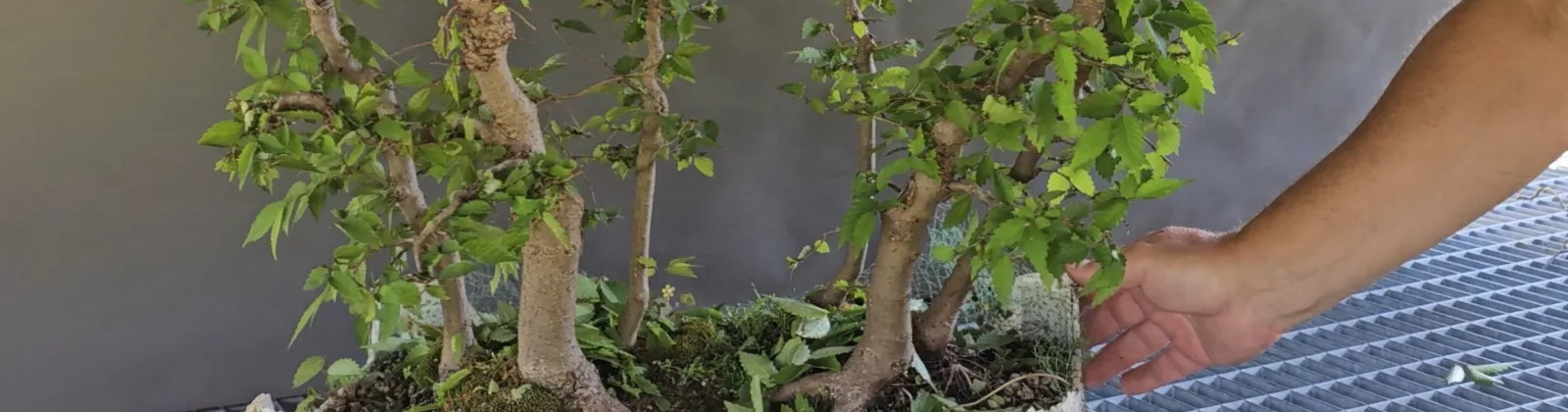
Zelkova Bonsai Forest: Summer Pruning and Defoliation for Fine Ramification
A zelkova bonsai forest is one of the most rewarding — and most demanding — compositions in the bonsai forest style. The species (Zelkova serrata, not to be confused with the so called “Zelkova nire”, which is actually an elm, Ulmus parvifolia) grows fast and pushes hard, which is exactly what makes it ideal for group plantings and exactly what makes zelkova bonsai pruning a non-negotiable part of summer care. Left alone after the first flush, a healthy forest turns into a dense wall of oversized leaves and runaway shoots that shade out the trunks and quietly kill the fine, refined buds closest to the wood. Those interior buds are the most valuable thing the tree owns, and they are the first to be sacrificed when the canopy closes over itself.
This article walks through a single decisive intervention on a six-trunk zelkova serrata bonsai forest in the middle of a heatwave: stopping the spring runs, selecting branches by direction and movement, and defoliating the most vigorous trunks to drive light back toward the centre. The logic mirrors the ramification work we apply to other deciduous species — the same patience you see in Acer palmatum development — but a forest changes the rules, because here the trunks are the primary branches and everything above them has to be built from scratch, fine and credible, year after year.
Enjoying this tutorial? Subscribe to our YouTube channel for weekly bonsai videos.
Why Zelkova Bonsai Pruning Cannot Wait in Summer
Zelkova is a fast, alternate-leaved deciduous species, and a vigorous zelkova bonsai forest can push an alarming amount of growth between early spring and the first hot weeks of summer. By the time the new shoots have hardened, two problems are already in motion. First, the long extensions are thickening the branches they grow from — and on a forest where you want thin, tapering ramification, that thickening is the opposite of the goal. Second, the broad outer leaves have closed over the interior, shading the small, fine buds nearest the trunk until the tree decides they are no longer worth feeding and lets them dry out.
Bonsai summer pruning on a zelkova does two things at once. It halts the runs before they damage the structure, and it reopens the canopy so light reaches the interior buds — the short, refined growth that future ramification depends on. In a heatwave the urgency is higher, not lower: photosynthesis in the shaded interior is already inefficient, so a tree under heat stress is even quicker to abandon the back buds it cannot light. This is the single most time-sensitive aspect of zelkova bonsai care: intervene a few weeks late and the forest will have made that selection for you, and rarely in your favour.
Let Leaf Size Guide the Cut, Not Bud Counting
The textbook instruction for zelkova bonsai pruning is to cut back to the first two internodes. On a single refined tree that is workable. On a forest carrying thousands of shoots, counting buds on every one is simply not realistic — there is not enough time in the session, and the work would never finish.
The practical shortcut is to read leaf size instead. A zelkova shoot begins the season with tiny leaves at its base — the good ones, the ones you want — and progressively larger leaves toward the tip as the extension keeps running. So the leaves themselves tell you where you are: when the leaves have become noticeably large, you are already well past the first internodes and it is time to cut. Shorten back to where the leaves are small, keeping roughly two internodes, occasionally three, never more.
Branch Selection in a Zelkova Bonsai Forest
In the bonsai forest style the trunks serve as the primary branches — they are already formed and complete. The job above them is to build ramification that is fine, credible, and predominantly horizontal. That single principle decides almost every cut. Anything growing toward the interior of the composition, straight up, or straight down is removed. What stays are the branches heading outward — to the front, the flanks, and the back — ideally without running into a neighbouring trunk.
Within that rule there is a hierarchy. Remove branches born inside the curves, branches with unnatural movement, and the thicker branches when a thinner alternative exists in the same spot — on a zelkova bonsai forest you almost never want to build heavy branches. Where two shoots cross, keep the one whose direction serves the design and cut the other, usually favouring the finer of the two. Avoid clusters of shoots erupting from a single point: a tuft of branches all leaving the same node reads as artificial and has to be thinned to one.
Height changes the calculus. Low on each trunk you can be strict and keep only clean horizontal branches; the lowest branch is also the longest, so it is left a little longer to reach its light. As you climb, you accept progressively more upward-angled shoots and tolerate less-than-perfect directions, always preferring the finer branches to keep a sense of height and maturity toward the apex. The same discipline used to develop young pre-bonsai applies here, multiplied across every trunk in the group.
Zelkova Bonsai Defoliation: Restoring Light to the Interior
On the most vigorous trunk — in this zelkova serrata bonsai forest, the dominant main trunk — pruning alone is not enough. So many leaves emerge directly from the trunk that the structure is invisible, and selecting branches is impossible until the excess is removed. Here the work becomes a partial defoliation: stripping the oversized, downward and interior leaves wholesale, simply to see what remains and to flood the centre with light again.
Zelkova bonsai defoliation does more than reveal the structure. Beside the petiole of every leaf sits a dormant bud, and removing the leaf stimulates that bud to open. Take the leaves and you keep the ramification response while bringing light and air back to the interior. The tree reads the change and reacts: after a summer defoliation a vigorous zelkova bonsai pushes a new flush that is both more numerous and made of much smaller leaves — exactly the fine growth a refined canopy needs.
Not every trunk needs it. The point of defoliating is to solve a density problem on the trunks that have one. Where light still penetrates and the branches are already legible, leaving the foliage in place is the correct, more conservative choice. Defoliation is a tool for excess vigour, not a routine to apply uniformly across the group.
Zelkova Bonsai Care Trunk by Trunk
A forest is not one tree, and treating every trunk identically is a mistake. In this composition the dominant trunk was congested enough to demand defoliation, while the smaller trunks — planted slightly higher, given less room, and naturally less vigorous — were nowhere near as full. On those, neither defoliation nor aggressive cutting was warranted. The right move was the opposite: leave the existing branches you intend to keep, let them claim their space and strengthen, and allow that strength to suppress unwanted new shoots from the trunk so the structure can be refined later. Understanding this difference is central to zelkova bonsai care — each trunk in the forest needs its own approach.
The smaller trunks also need an apex, and this is the moment to set one. On a less vigorous trunk you can promote a well-placed shoot to leader — choosing one that angles toward the viewer and sits as the highest point of that tree. As a rule, the finer and more upward-reaching the growth toward the top, the better: the tightening density from base to apex is what gives each trunk, and the forest as a whole, its sense of height and age.
| Branch trait | Keep the branch | Remove the branch |
|---|---|---|
Direction | Outward: front, flanks or back | Inward, straight up, or straight down |
Position | Outside of a curve, clean origin | Inside a curve, or running into another trunk |
Thickness | Fine, in proportion to its trunk | Thick when a finer alternative exists nearby |
Leaf size at the tip | Small leaves close to the trunk | Large leaves far from the first internodes |
Crossing shoots | The one whose movement serves the design | The crossing partner, usually the coarser one |
Origin point | A single, well-spaced shoot | Tufts of several shoots from the same node |
Building a Bonsai Forest Style: Six Trunks and the Seventh to Come
This zelkova bonsai has been in development for about two years. It arrived as an even bushier, denser, less credible shrub with genuinely interesting trunks, and the first intervention — made in roughly this same season — was to clear the dispersed ramification far from the trunks and bring the composition back in toward itself. Two air layers (margotte) followed, removing structural problems: the main trunk split at mid-height into two near-equal stems — a slingshot fork — and one trunk was completely straight, jarring against the natural movement of the others.
Removing that straight trunk left the zelkova serrata bonsai forest at six trunks — an even number, a so-called mortal sin under classical bonsai forest style rules. In practice it is not as bad as the rule-book insists, but the plan is to reintroduce a seventh: the very trunk that was air-layered and kept, an old, mature stem with real character, slotted in somewhere on the left to restore an odd count and add perspective and depth. Possibly more fine trunks will follow. For now the spring runs are stopped, the canopy is back under control, and the forest will react with smaller, more numerous shoots — meaning one, two, perhaps three more interventions before the season ends. The structure is set; the refinement is just beginning.
Key Takeaways
- In a zelkova bonsai forest the trunks are the primary branches — everything above them must be built fine, credible and predominantly horizontal
- Bonsai summer pruning cannot wait: unchecked runs thicken branches and shade out the fine interior buds that future ramification depends on
- Let leaf size guide your zelkova bonsai pruning instead of counting buds — when leaves are large you are already past the first internodes
- Always leave a few leaves behind a cut, or the tree may abandon the branch entirely
- In the bonsai forest style, keep outward horizontal branches and remove anything heading inward, up, down, or into a neighbouring trunk
- Zelkova bonsai defoliation restores light and triggers the dormant bud beside each petiole — use it only on over-vigorous trunks, not as a routine
- Zelkova bonsai care means treating every trunk according to its own vigour — expect smaller, more numerous shoots requiring one to three more interventions this season
Frequently Asked Questions
When should I summer prune a zelkova forest bonsai?
Prune as soon as the spring flush has produced clearly vigorous shoots with long internodes and visibly enlarged leaves, typically from late spring into early summer. The exact date matters less than the state of the tree: act once the runs are obvious but before the wood hardens. In hot weather the urgency increases, because a heat-stressed zelkova photosynthesises less efficiently in its shaded interior and will quickly abandon the fine back buds it cannot light. Waiting too long means the tree makes that selection for you, usually removing the very buds you wanted to keep.
How do I know how far back to cut a zelkova shoot?
Use leaf size as your guide rather than counting buds, which is impractical on a forest carrying thousands of shoots. A zelkova shoot starts the season with tiny leaves at its base and grows progressively larger leaves toward the tip. When the leaves have become noticeably big, you are already well past the useful first internodes, so cut back to where the leaves are small — keeping roughly two internodes, occasionally three, never more. Always leave a few leaves behind the cut so the plant does not abandon the branch.
What is the purpose of defoliating a zelkova bonsai in summer?
Summer defoliation serves two goals on an over-vigorous trunk. First, it reveals a structure otherwise hidden under a wall of leaves, making real branch selection possible. Second, it restores light and air to the interior and stimulates the dormant bud that sits beside the petiole of every leaf, encouraging finer ramification. A defoliated zelkova reacts with a new flush that is both more numerous and made of much smaller leaves. It is a tool for excess vigour, however, not a routine — apply it only to congested trunks, and leave less vigorous trunks fully leaved.
Which branches should I keep when refining a zelkova forest?
Keep branches that grow outward — toward the front, flanks, and back of the composition — and that are predominantly horizontal and fine. Remove anything heading into the interior, straight up, straight down, or into a neighbouring trunk, along with branches born inside curves or with unnatural movement. Where shoots cross, keep the one whose direction serves the design and cut the other, usually the coarser. Avoid tufts of several shoots from one node. Lower on each trunk be strict and horizontal; higher up, accept more upward angles and favour the finest branches to build height and maturity.
Is an even number of trunks really a problem in a forest bonsai?
Classical bonsai convention treats an even number of trunks — and especially the symmetry it can imply — as something to avoid, which is why odd counts are the default in group plantings. In practice a six-trunk forest is far from ruined; the rule is a guideline, not a law, and a well-balanced even composition can read perfectly well. That said, returning to an odd number adds flexibility for asymmetry, depth, and perspective, which is why the plan here is to reintroduce a seventh trunk — an old, characterful stem kept from an earlier air layering — to enrich the composition.

Luca Valagussa
Bonsai is not the result: that comes after. Your enjoyment is what is important.
John Yoshio Naka