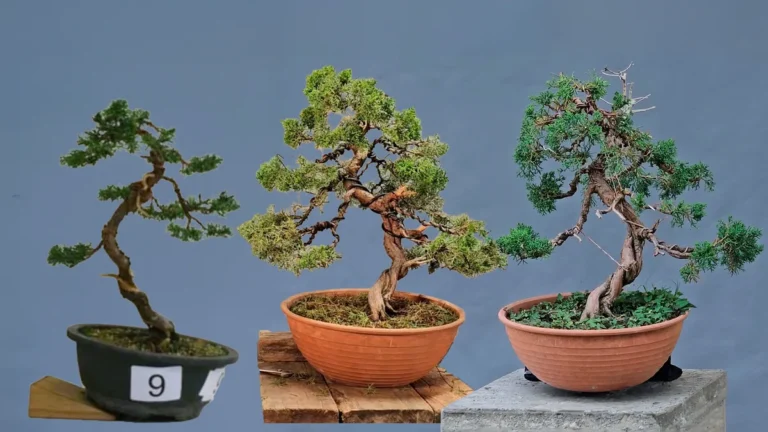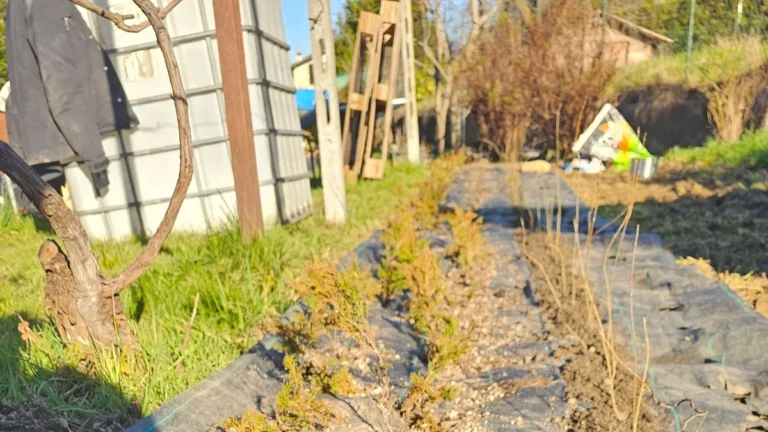
Most Japanese maples develop smooth bark that transitions from green or red tones to grey with age. For arakawa bonsai enthusiasts and anyone interested in trunk texture, this means the winter silhouette relies almost entirely on branch structure — the trunk itself offers little visual presence.
Arakawa and Allen’s Gold are the exceptions.
These are the only two Acer palmatum cultivars that develop rough, cracking bark resembling pine bark — a trait that adds trunk character, visual maturity and year-round interest to deciduous bonsai. Both are vigorous, upright growers suited for trunk building, and both are propagated from cuttings at Treevaset to preserve true bark development from the base.
If you are considering a rough bark Japanese maple for bonsai, this comparison will help you choose between the classic and the newcomer.
What Makes Rough Bark Different?
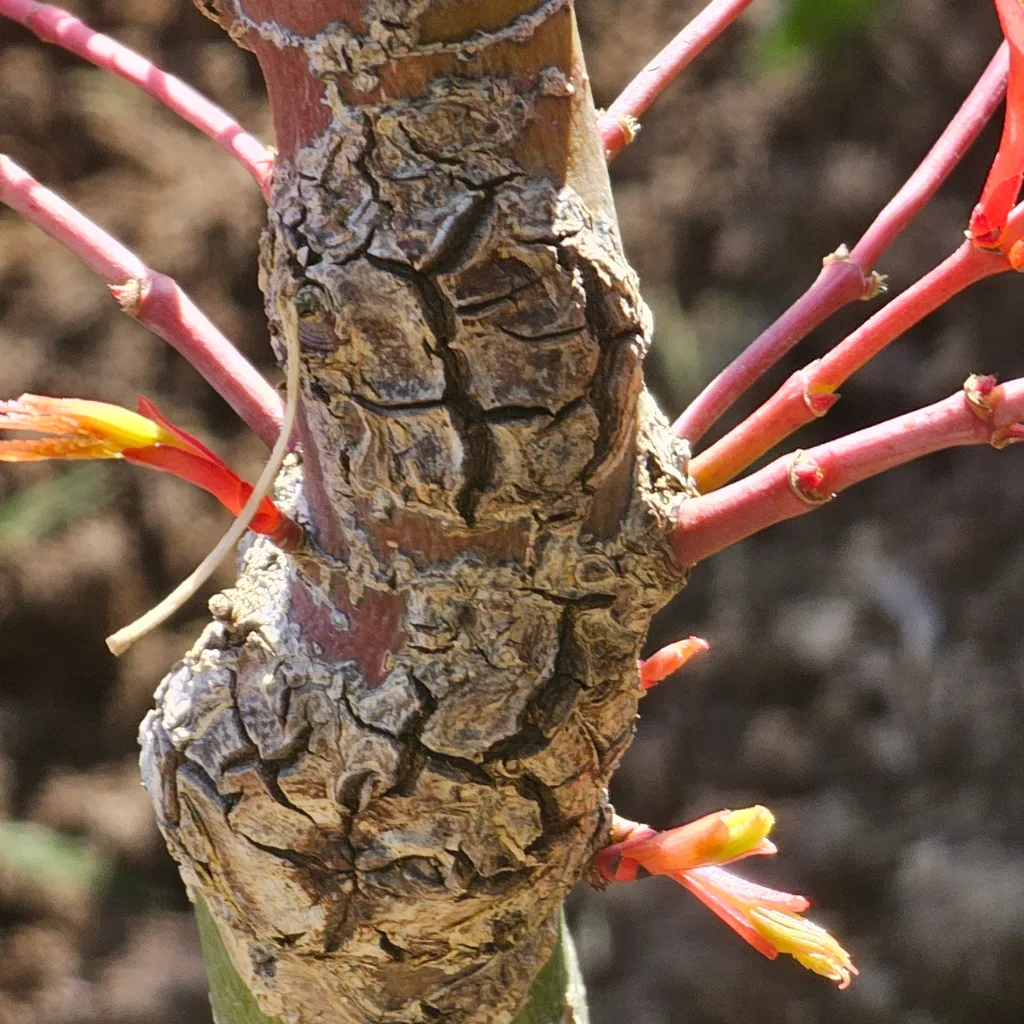
Most Acer palmatum cultivars produce smooth bark throughout their life. Rough bark cultivars are genetically distinct: their bark begins cracking into corky, fissured scales after approximately four years of growth, eventually developing a texture that resembles mature pine bark.
This trait is rare among Japanese maples and carries specific implications for bonsai:
- Winter presence: rough bark adds trunk texture that compensates for the absence of foliage, giving the tree visual weight year-round.
- Visual maturity: a rough-barked maple at five years can look decades older than a smooth-barked tree of the same age.
- Wire mark recovery: wire scars become less visible as bark texture develops and cracks over existing marks — an advantage during structural training phases.
Why propagation method matters
Rough bark only develops fully on trees grown from cuttings or air layers. Grafted specimens develop rough bark above the graft union, but the rootstock below remains smooth — creating a visible mismatch at the trunk base that undermines the natural appearance of the tree.
All rough bark cultivars at Treevaset are cutting-propagated, ensuring bark character develops uniformly from the roots upward.
Arakawa — The Classic Rough Bark Maple
‘Arakawa‘ is the original and most recognised rough bark Japanese maple. The name itself means “rough bark” in Japanese (ara = rough, kawa = bark).
Bark development
Young shoots emerge red, turning deep green or deep red depending on sun exposure. Around year four, the bark transitions to grey and begins cracking into the characteristic pine-bark scales that define the cultivar. The progression is gradual — early fissures deepen and widen over the following years, creating increasingly pronounced texture.
Seasonal colour
- Spring: light green leaves with red margins — understated but clean.
- Summer: stable light green.
- Autumn: deep orange and purple — one of the most dramatic autumn displays among rough bark cultivars.
Growth behaviour
Vigorous and upright with fast growth pace, long internodes and large leaves. Adult size in open ground: 3 to 5 metres. Arakawa is built for trunk development — its energy supports rapid caliper increase when managed correctly.
In my experience
The classical, iconic pine bark maple. Rough bark and yet delicate leaves, with brilliant colours in autumn.
Allen’s Gold — Rough Bark Meets Spring Colour
‘Allen’s Gold‘ is a newer cultivar that combines Arakawa-type bark character with the vivid spring foliage of Katsura. Where Arakawa offers subtle spring emergence and dramatic autumn, Allen’s Gold reverses the emphasis — its spring is the spectacle.
Bark development
The bark progression in Allen’s Gold follows a different colour path than Arakawa. Young shoots start yellow, turning light green and then deep red until around year four, when the bark turns grey and begins cracking into scales. The texture is comparable to Arakawa — rough, fissured, pine-bark character — but the early colour stages are distinctive and warmer in tone.
Seasonal colour
- Spring: luminous golden-chartreuse foliage with vivid pink-red margins — the most striking spring display of any rough bark maple.
- Summer: settles into light green.
- Autumn: yellow to orange tones — warm but less dramatic than Arakawa’s deep orange-purple.
Growth behaviour
Vigorous and upright with fast growth pace, long internodes and large leaves. Adult size in open ground: 3 to 5 metres. Structurally very similar to Arakawa — both are trunk-building cultivars that require internode management during refinement.
In my experience
A maple with the bark of Arakawa and the leaves of Katsura. What can you ask more!?
Side-by-Side Comparison
| Feature | Arakawa | Allen’s Gold |
|---|---|---|
| Bark texture | Rough, pine-bark scales | Rough, pine-bark scales |
| Bark colour progression | Red → deep green/red → grey | Yellow → light green → deep red → grey |
| Spring colour | Light green, red margins | Golden-chartreuse, pink-red margins |
| Summer colour | Light green | Light green |
| Autumn colour | Deep orange and purple | Yellow to orange |
| Growth habit | Vigorous, upright | Vigorous, upright |
| Growth pace | Fast | Fast |
| Internodes | Long | Long |
| Leaf size | Large | Large |
| Adult size | 3-5m | 3-5m |
| Best season | Autumn + winter bark | Spring + winter bark |
Which One Should You Choose?
Choose Arakawa if:
You value the classic, time-tested rough bark maple with the deepest autumn colour.
Your priority is winter trunk presence combined with dramatic orange-purple leaf drop.
You want the cultivar with the longest track record in bonsai collections worldwide.
Choose Allen’s Gold if:
You want rough bark character combined with a striking spring colour display.
The golden-chartreuse and pink-red spring foliage is something no other rough bark cultivar offers.
You want a tree that stands out in spring and winter — covering two seasons where most deciduous bonsai are visually quiet.
Either way:
Both cultivars share the same vigorous, upright growth profile and build trunk caliper quickly. They reach 3–5 metres in open ground and require internode control during refinement. Cutting propagation is essential to develop bark from the base — all Treevaset stock meets this requirement.
Development Considerations for Bonsai
Rough bark Japanese maples share structural characteristics that affect bonsai development:
Trunk building is their strength. Both Arakawa and Allen’s Gold are fast growers with strong energy. The trunk thickens quickly under open cultivation, making them excellent candidates for early structural work — sacrifice branches, directional wiring and taper development.
Refinement requires patience and strategy. Long internodes and large leaves are standard during vigorous growth. As ramification increases and feeding is moderated, both leaf size and internode length reduce progressively. This transition takes time and should not be rushed.
Structural planning and styling
Back-budding is moderate. Neither cultivar produces adventitious buds as freely as some compact cultivars. Structural planning should account for this — branch placement decisions made early are harder to correct later. Maintaining interior light penetration is essential to preserve lower and inner branching.
Wire marks fade naturally. One practical advantage of rough bark: as the bark texture develops and scales crack, existing wire marks become less visible over time. This allows slightly longer wiring periods compared to smooth-barked cultivars where scars persist indefinitely.
Best bonsai styles: Informal upright (moyogi) and slanting (shakan) suit both cultivars well. The bark texture adds credibility to styles that suggest age and exposure. Formal upright demands stricter internode control than either cultivar naturally provides.
Watch: Nebari Work and Air Layering on an Arakawa
No voice-over, no music — just the real sounds of nebari work on an Arakawa, analysing and improving the root base, finished with an air layer that splits the tree into two.
Explore Rough Bark Japanese Maples at Treevaset
Both Arakawa and Allen’s Gold are available as young pre-bonsai — cutting-propagated, non-grafted, and selected for early structural potential.
Acer palmatum 'Arakawa' – Japanese Maple for Bonsai
Price range: 25 € through 60 €
Sold out — next batch in preparationFor a full comparison of all Acer palmatum cultivars in our collection, see our Acer palmatum cultivar comparison.
Frequently Asked Questions
How long does it take for rough bark to develop?
Both Arakawa and Allen’s Gold begin developing rough bark around year four. Early fissures appear first, then deepen and widen over the following years. Full pine-bark character typically takes five to seven years to become pronounced. Trees grown from cuttings develop bark from the base — grafted trees only develop it above the graft union.
Can grafted rough bark maples develop bark on the lower trunk?
No. Grafted specimens develop rough bark only above the graft union. The rootstock below remains smooth, creating a visible mismatch. For bonsai, cutting-propagated or air-layered trees are essential to achieve uniform bark character from the roots upward.
Which rough bark maple is better for beginners?
Both Arakawa and Allen’s Gold share the same vigorous, forgiving growth profile. Neither is more difficult than the other. The choice comes down to seasonal preference: Arakawa for dramatic autumn colour, Allen’s Gold for striking spring foliage. Both build trunk quickly and tolerate the learning curve of early bonsai development.
Do Arakawa and Allen’s Gold need different care?
No. Both cultivars share nearly identical growth behaviour — vigorous, upright, fast-growing with long internodes. Care requirements (watering, light, feeding, repotting) are the same. The only visible difference is bark colour progression and seasonal foliage colour.