Choosing the right Acer palmatum cultivar for bonsai development is not about autumn colour. It is about structural behaviour.
Seigen, Beni Chidori and Orihime are three Japanese maple cultivars frequently selected for Young Pre-Bonsai. All can be trained successfully. However, their vigour, internode tendency, ramification response and seasonal rhythm differ in ways that directly influence long-term structure.
If you are asking:
- Which Japanese maple is best for bonsai?
- Which cultivar has shorter internodes?
- Which Acer palmatum is better for shohin?
- Which one thickens faster?
This structural comparison will help you decide.
Quick Answer
- Choose Beni Chidori if your priority is trunk thickening and early structural development.
- Choose Seigen if you want balanced growth and easier transition from development to refinement.
- Choose Orihime if your goal is compact shohin bonsai with naturally short internodes.
The correct choice depends on development phase, final size objective and your tolerance for internode management.
This article focuses on three cultivars suited for different development phases. For a full comparison of all eight Acer palmatum cultivars in our collection — including Katsura, Deshojo, Koto Hime, Sei Hime and Allen’s Gold — see acer palmatum cultivars.
Quick Structural Overview
| Cultivar | Leaf size | Internodes | Growth habit | Spring colour | Bark | Adult size |
|---|---|---|---|---|---|---|
| Orihime | Very small | Short | Dwarf, compact | Light green, bronze margins | Smooth | 1–2m |
| Seigen | Medium | Medium | Semi-dwarf, upright | Red-purple | Smooth | 1–2m |
| Beni Chidori | Medium | Medium | Semi-dwarf, upright | Pink to orange | Smooth | 2–4m |
This overview simplifies the decision. The sections below explain what these differences mean in practice.
Seigen – Balanced Structural Development
Acer palmatum ‘Seigen’ is often selected by growers seeking controlled development without excessive elongation.
Growth Behaviour
- Moderate vigour
- Internodes generally manageable under balanced feeding
- Predictable seasonal rhythm
Structural Implications
Seigen allows trunk progression while keeping branch spacing under control. It does not tend toward aggressive extension, which reduces the need for constant internode correction during refinement.
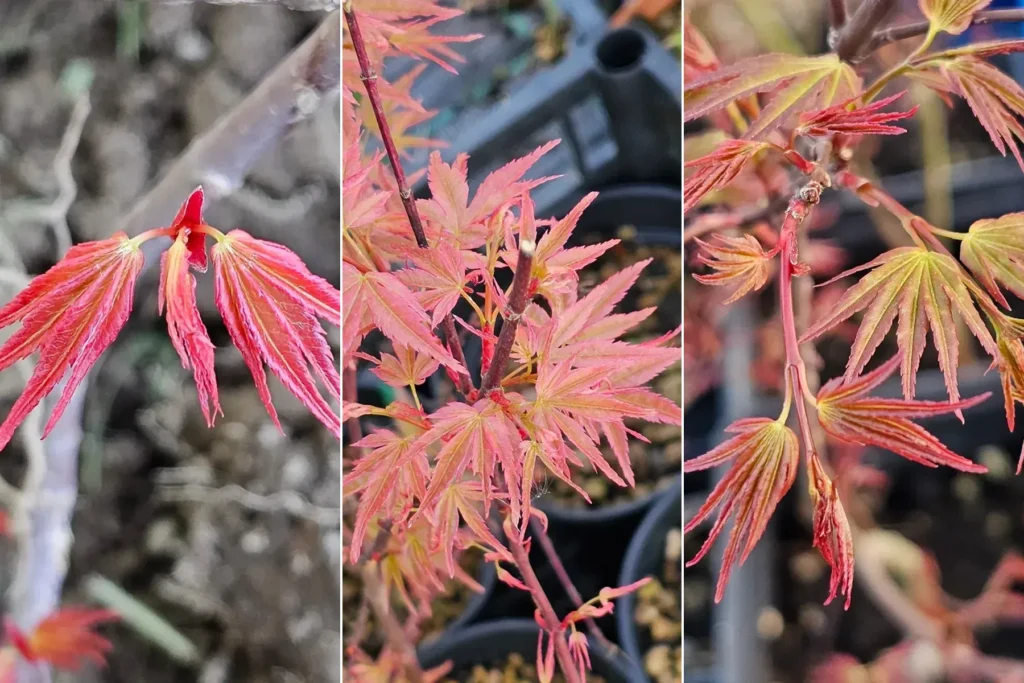
Bark is smooth throughout, with distinctive pink-red tones on younger branches. Spring flush emerges as a very intense red-purple before turning light green — one of the most striking seasonal transitions among Acer palmatum cultivars. In open ground, Seigen reaches just 1 to 2 metres, making it naturally suited to smaller-scale bonsai.
Seigen is suitable for:
- Growers transitioning from trunk building to structural refinement
- Shohin-sized bonsai projects
- Balanced long-term development
If your goal is steady structural control without sacrificing growth entirely, Seigen offers flexibility.
Beni Chidori – Stronger Extension and Development Momentum
Acer palmatum ‘Beni Chidori’ (sometimes written “Benichidori”) shows stronger vegetative extension compared to Seigen and Orihime.
Growth Behaviour
- Moderate to strong vigour
- Internodes can elongate under high nitrogen
- Reliable back-budding when healthy
Structural Implications
This cultivar supports faster trunk thickening and primary branch establishment. During early development, this added vigour can accelerate structural progress.
Bark is smooth, displaying green, pink or red tones depending on sun exposure. Spring colour is spectacular: leaves emerge pink, then shift to pink with orange veins before settling into light green by summer. Crimson red autumn. In open ground, Beni Chidori reaches 2 to 4 metres — the most vigorous of the three, which explains its advantage in trunk development.
However, during refinement phases, internode control becomes more relevant.
Beni Chidori is particularly suitable for:
- Early-stage Young Pre-Bonsai
- Projects where trunk development is the priority
- Growers comfortable managing extension growth
If your focus is building structure before refinement, Beni Chidori provides momentum.
Orihime – Naturally Compact Structure
Acer palmatum ‘Orihime’ is known for compact growth and smaller foliage.
Growth Behaviour
- Short internodes under balanced conditions
- Dense branching tendency
- Slower overall extension
Structural Implications
Orihime simplifies internode management and supports tight branching patterns. However, trunk thickening may progress more slowly compared to more vigorous cultivars.
Bark is smooth, progressing from light green to grey with maturity. Spring foliage opens in light green with subtle bronze margins. In open ground, Orihime stays between 1 and 2 metres — the most naturally compact of the three, reinforcing its suitability for shohin work.
This cultivar is particularly suitable for:
- Shohin bonsai development
- Compact Japanese maple bonsai projects
- Growers prioritising structural precision over rapid thickening
If your objective is small-scale precision, Orihime offers natural compactness.
Best Choice by Target Size
For Shohin Bonsai (Small Scale)
Orihime offers the most naturally compact behaviour.
Seigen can also be appropriate with careful feeding control.
For Medium-Sized Bonsai
Seigen provides balanced growth that supports both trunk development and ramification.
For Early Trunk Development
Beni Chidori’s stronger extension supports faster structural progression.
Selecting the cultivar based on final size objective reduces corrective pruning later.
Internode Management in Practice
Internode length is not determined by genetics alone. Cultivar tendency interacts with cultivation strategy.
Key control factors include:
- Nitrogen levels and fertilisation timing
- Sun exposure and extension intensity
- Pruning timing during active growth
- Defoliation strategy (when appropriate and cultivar-suitable)
A moderately vigorous cultivar under controlled feeding may produce shorter internodes than a compact cultivar under excessive nitrogen.
Cultivar choice defines tendency, but management determines outcome.
Which Acer Palmatum Cultivar Is Best for Bonsai?
There is no universal “best” Japanese maple for bonsai.
Instead, consider:
- Your current development phase
- Desired final size
- Time horizon for trunk thickening
- Tolerance for internode correction
- Long-term structural planning
Cultivar behaviour influences trajectory, not final success.
Structural Factors That Matter More Than Colour
When selecting a Japanese maple bonsai cultivar, evaluate:
- Internode tendency
- Back-budding reliability
- Growth vigour
- Seasonal rhythm
- Ramification density potential
Autumn colour is visually attractive, but during structural development it is secondary.
Explore These Cultivars at Treevaset
All three cultivars are grown at our nursery as Young Pre-Bonsai — cutting-propagated, non-grafted, and selected for early structural potential. Beni Chidori is the most requested of the three; when it is sold out, you can join the waiting list to be notified at the next restock.
Acer palmatum ‘Beni Chidori’ – Japanese Maple for Bonsai (Young Pre-Bonsai)
Price range: 35 € through 45 €
Sold out — next batch in preparationFrequently Asked Questions
Which cultivar has the shortest internodes?
Orihime typically shows the most compact internode tendency under balanced feeding. Seigen follows closely. Beni Chidori may elongate more under high vigour conditions.
Which cultivar thickens faster?
Beni Chidori generally thickens faster due to stronger extension growth.
Is Orihime always best for shohin bonsai?
Orihime simplifies compact structure, but Seigen can also produce excellent shohin results with appropriate internode control.
Can Beni Chidori be refined successfully?
Yes. It requires more active internode management during refinement, but it remains structurally reliable.
What matters more than cultivar name when buying pre-bonsai?
Root stability, trunk movement, internode distribution and early structural potential are often more decisive than cultivar alone.
Final Consideration
Acer palmatum cultivars differ in behaviour, not only in appearance.
Choosing the right cultivar for bonsai is about aligning structural tendency with your development objective. Understanding growth behaviour before purchase reduces corrective work later and supports long-term structural clarity.
Anyone can play bonsai with the right knowledge.