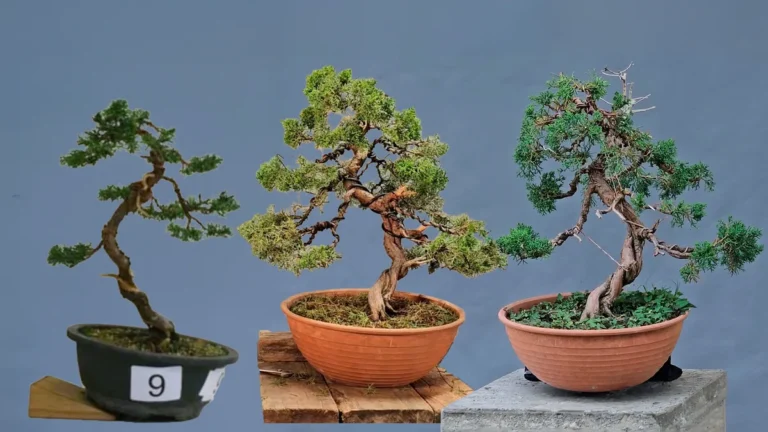
Some trees demand patience. The Acer palmatum Shishigashira is one of them — and the rewards for those who wait are extraordinary. In this video, Luca Valagussa shares the full development history of a Shishigashira with 19 years behind it: from a mother plant he has known since the beginning, through air layering, root selection, and the early stages of a sokan (double trunk) design that is already taking shape.
What makes this project remarkable is the timeline. The air layer was applied in June 2023 and not separated until June 2024 — nearly a full year. Most air layers on maples are removed within a few months. But Shishigashira is not most maples. Its slow growth rate, compact internodes, and dense foliage make it one of the most desirable — and most demanding — cultivars in Acer palmatum bonsai development.
This post follows the complete journey: why Luca chose to air layer rather than use other propagation methods, how he managed the slow rooting process, the root work and nebari-building techniques he used after separation, and the styling decisions that turned raw material into a sokan with real potential. If you work with Japanese maples or are considering Shishigashira as bonsai material, this is the kind of long-term case study that reveals what the cultivar actually requires.
Anyone drawn to Shishigashira’s dense, compact canopy but after a cultivar that builds structure faster will find similarly short internodes — with noticeably more vigour — in Acer palmatum ‘Koto Hime’.
Enjoying this tutorial? Subscribe to our YouTube channel for weekly bonsai videos.
What Makes Shishigashira Special for Bonsai
Shishigashira — the “lion’s head maple” — stands apart from other Acer palmatum cultivars in almost every way that matters for bonsai. The leaves are deeply crinkled and grow in dense, compressed clusters at the tips of branches, giving the canopy an unmistakable texture that no other variety can replicate. The bark develops character early, becoming rough and fissured even on young trunks. And the internodes are naturally short, which means compact ramification without constant pinching.
These qualities make it one of the most sought-after cultivars for bonsai work. They also make it one of the slowest.
Where a standard Acer palmatum might push 15–20 centimetres of extension growth in a strong season, Shishigashira manages a fraction of that. Every phase of development — thickening, branching, recovery from cuts — takes longer. This has a direct impact on how you plan and execute every technique, from propagation to styling. Rushing Shishigashira does not produce mediocre results; it produces failure. The cultivar rewards deliberate, multi-year planning and punishes impatience.
For bonsai enthusiasts looking for material that builds genuine character over time — trunk texture, compact canopy, autumn colour — Shishigashira delivers at a level few other maples can match. But you need to work on its schedule, not yours.
Air Layering Shishigashira: Why a Full Year Was Necessary
Luca applied the air layer in June 2023 on his 19-year-old mother plant. The standard approach with most Acer palmatum varieties would be to check roots after three to four months and separate before dormancy. With Shishigashira, Luca took a different path — and it was a deliberate decision, not hesitation.
The first check — and closing it back up
Partway through the process, Luca opened the wrap to inspect progress. Roots had begun to form, but only on part of the circumference. This is the moment where many growers would separate, accepting whatever root distribution they have and planning to correct deficiencies later. Luca closed it back up.
His reasoning is straightforward: for a high-quality nebari, you need roots distributed evenly around the entire circumference of the trunk base. A few strong roots on one side and nothing on the other means years of corrective work — growing sacrifice roots, adjusting angles, grafting. Getting full radial coverage at the air layer stage eliminates all of that downstream work.
Why Shishigashira needs more time
The slow growth rate that makes Shishigashira so desirable for bonsai is exactly what makes its air layers slower to root. The metabolic pace is lower. Callus formation is slower. Root initiation takes longer. Luca let the air layer run for almost twelve months — through summer, autumn, dormancy, and back into the following spring — before the root coverage met his standard.
This patience paid off. When he finally separated the air layer in June 2024, the roots were distributed all the way around the circumference. No gaps. No dominant roots on one side. The nebari quality at separation was already better than what most air layers achieve after years of post-separation correction.
Autumn colour as a bonus signal
An interesting observation from Luca’s experience: air-layered Acer palmatums often produce particularly vivid autumn colours the year they are layered. His Shishigashira was no exception — the fall 2024 display was striking. While this is not a universal rule, it is a pattern Luca has noticed repeatedly across his air-layered maples.
Root Work and Nebari Development After Separation
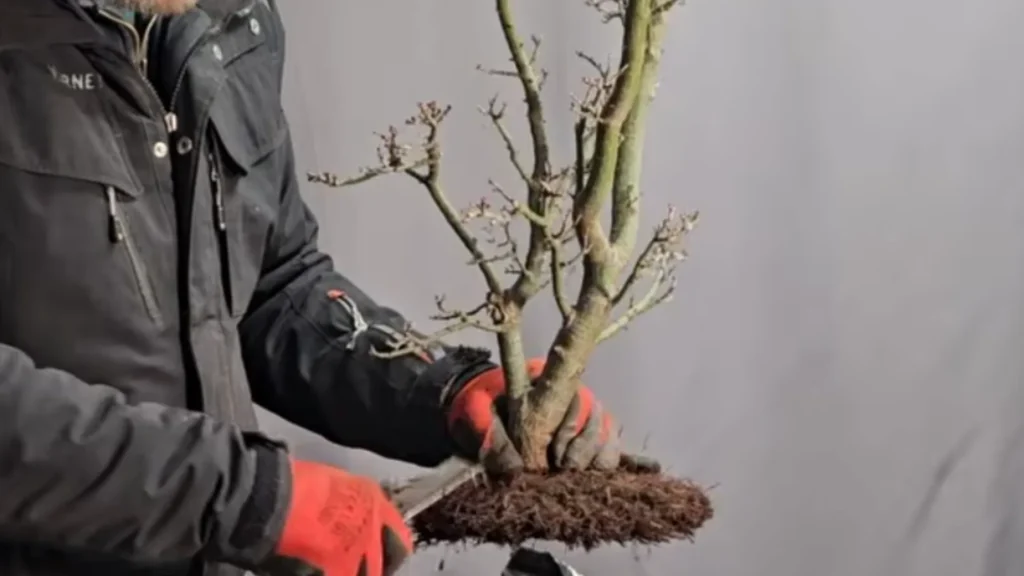
After separating the air layer in June 2024, Luca performed a rough root selection and applied a technique that is central to his nebari-building approach: a wooden plate at the base of the trunk.
The wooden plate technique
The plate sits directly under the trunk base, forcing roots to spread outward horizontally rather than growing straight down. This radial spread is what creates the flared, table-like nebari that distinguishes a high-quality bonsai from one that simply has roots. Combined with the already-radial root distribution from the air layer, the plate accelerates nebari development significantly.
After the initial separation and root trim, the tree grew in a training box for the rest of 2024. No heavy interventions — just recovery and establishment.
January 2025: the first full repot
When Luca repotted the tree in January 2025, he was genuinely impressed by the root quantity. The air layer had produced an abundance of roots — enough that selection became the main task rather than preservation.
His selection criteria were precise:
- Position: roots needed to radiate outward from evenly spaced points around the circumference
- Trunk attachment: clean connections to the trunk base, no crossing or tangling
- Size: proportional to the trunk diameter — oversized roots were removed to keep the nebari balanced
- Direction: each root had to point outward and slightly downward, contributing to the radial pattern
Luca describes it as an embarrassment of riches — having too many good roots to choose from, rather than struggling to keep every root alive. He cut aggressively short to encourage further capillarisation (fine root branching closer to the trunk), reapplied the wooden plate, and let the tree grow undisturbed for six months.
This is a pattern worth noting: after significant root work, Luca does not intervene above ground. The tree needs all its energy directed at rebuilding the root system. No pruning, no wiring, no styling. Until new growth appears and stabilises, the tree rests.
Sokan Styling: Building a Double Trunk Design
By May 2025, the tree had recovered fully from the January root work and was growing strongly. This was the moment Luca began studying the material for its styling potential — and he saw a sokan (double trunk).
Why sokan suited this tree
The trunk naturally divided into two main lines with distinct movement. When viewed from the chosen front, the two trunks create what Luca describes as a visual dialogue — they “call to each other,” their curves and inclinations creating tension and balance simultaneously. This is the essence of sokan: not just two trunks from a single base, but two trunks that relate to each other as father and son, larger and smaller, dominant and complementary.
The Shishigashira’s naturally compact growth habit is an advantage here. The dense, lion’s head foliage will eventually create two distinct canopy masses — each with its own apex and silhouette — without the leggy extension growth that would blur the boundary between the two trunks on a more vigorous cultivar.
The wooden spacer — no wire on Shishigashira bark
One practical challenge: the two trunks were growing too parallel, too close together. In most species, you would wire them apart. On Shishigashira, Luca chose a different approach — a small wooden spacer wedged between the trunks to push them apart gradually.
The reason is the bark. Shishigashira develops its distinctive rough, corky bark texture relatively early. Wire would bite into this bark and leave permanent scars that the tree cannot grow out. A wooden spacer applies gentle, constant pressure without any surface contact that could mark the bark. It is a slower method, but one that respects the material.
The result was remarkable. Between May and the following February — roughly nine months — the tree had already memorised the new trunk positions. The spacer could be removed, and the trunks held their separation. This speed of response, despite Shishigashira’s reputation for slow growth, shows that structural memory (the tree locking in a new position through secondary growth) operates on a different timeline than extension growth.
Future Development Plan
With the sokan structure established, Luca outlined several next steps for the tree’s continued development:
Removing a competing trunk. One secondary trunk line competes with the main father-son composition. Removing it will simplify the design and direct energy to the two primary trunks. This kind of subtraction — removing material that is technically healthy but compositionally redundant — is one of the hardest decisions in bonsai development, and one that defines the difference between growing a tree and designing one.
Stopping the apices. Both the father and son trunks need their apical growth halted at the right height. The goal is to achieve similar branching structure on both trunks — not identical, but harmonious. Stopping the apex forces energy into lateral branching and secondary ramification, building the canopy density that Shishigashira is known for.
Removing an oversized branch. One branch has thickened beyond what is proportional to the trunk at its attachment point. Rather than trying to incorporate it, Luca plans to remove it entirely. Keeping a branch that is too thick creates inverse taper — a flaw that only gets worse with time and is nearly impossible to correct later.
New air layers. Luca has already applied air layers on some of the material being removed. Rather than discarding pruned branches, he is propagating new trees from them — extending the 19-year genetic line of this Shishigashira into additional pre-bonsai material.
The son’s apex dilemma. The son trunk offers two possible apex choices, each leading the design in a different direction. Luca posed this as an open question to viewers — a genuine decision point where the path forward is not yet clear. This kind of transparency about unresolved design questions is rare, and it illustrates that even experienced growers face moments where the tree has not yet revealed its best direction.
Update, February 2026: The Anchoring Mistake That Nearly Undid the Nebari
The February 2026 repot of this tree turned into an honest lesson about what happens after the root work is done. At the January 2025 repot, the screw fixing the trunk to the wooden plate had been too small — or too short. It never gripped properly, the plate degraded in the substrate, and the trunk spent the entire growing season moving slightly against its own root ball.
The damage sat exactly where this tree could least afford it: at the surface. The movement had torn many of the fine capillaries, and part of the shallow nebari had dried out despite a covering of moss. Below the surface the picture was far better — white, healthy roots everywhere. The tree had escaped the worst, and one earlier choice helped: akadama around the base held moisture where pumice would have let the damaged sectors dry out completely.
The response was deliberately conservative: remove the dead roots, shorten lightly, and resist the temptation to dig deeper and explore the base. The wooden plate is gone for now — the base is flat and established, and what the tree needs next is unrestricted, vigorous root growth so the remaining roots can ramify, thicken and fuse. Instead, the trunk is now anchored firmly to the root ball with guy wires on both sides (left visible on purpose, to be removed by early summer before they mark the bark), planted deeper in a fabric pot, with sphagnum protecting the nebari through the summer heat.
The lesson is the one Luca repeats most often: it is rarely the cut itself that causes problems — it is what happens afterwards. A trunk that moves against its root ball tears every new capillary as it forms; solid anchoring is as much a part of a proper repot as any root decision.
Key Takeaways
- Shishigashira’s slow growth rate affects every technique — air layers, root development, and styling all require significantly more patience than standard Acer palmatum cultivars
- Leave air layers on slow-growing cultivars longer than usual — Luca waited nearly a full year to achieve complete root coverage around the circumference
- Check air layers partway through, and do not hesitate to close them back up if root distribution is incomplete — partial coverage is not good enough for quality nebari
- Use a wooden plate under the trunk base after separation to force roots outward into a radial pattern, building nebari structure from the earliest stage
- When root quantity allows it, cut roots aggressively short during repotting to encourage capillarisation — fine branching close to the trunk creates a denser, more refined nebari over time
- Avoid wire on Shishigashira bark — use wooden spacers to adjust trunk positions without scarring the characteristic rough bark texture
- After major root work, do not intervene above ground until new growth appears and stabilises — the tree needs all its energy directed at root recovery
- Structural memory works faster than extension growth — a wooden spacer can reposition trunks permanently in under a year, even on a slow-growing cultivar
Frequently Asked Questions
How long does it take to air layer an Acer palmatum Shishigashira?
Expect significantly longer than standard maples. Luca’s Shishigashira air layer took almost twelve months from application to separation — roughly three times longer than a typical Acer palmatum air layer. The slow metabolic rate of the cultivar means callus formation and root initiation both take longer. Separating too early risks getting roots on only part of the circumference, which creates years of corrective nebari work.
Can you wire Shishigashira bonsai branches?
You can wire smaller, younger branches where the bark has not yet developed its characteristic rough texture. However, on trunks and mature branches where the corky bark has formed, wire will leave permanent marks that the tree cannot grow out. For structural adjustments on thicker wood, mechanical methods like wooden spacers or guy wires (which distribute pressure over a wider area) are safer alternatives.
Why is Shishigashira considered difficult for bonsai?
The difficulty is not in keeping the tree alive — Shishigashira is a hardy Acer palmatum cultivar with good tolerance for typical European conditions. The challenge is time. Every developmental phase takes substantially longer than with standard palmatums. Thickening is slow, recovery from heavy pruning is slow, and air layers take longer to root. Growers accustomed to visible annual progress from other maples often become frustrated with Shishigashira’s pace. The cultivar rewards multi-year planning and punishes short-term thinking.
What is the wooden plate technique for nebari development?
A flat piece of wood (or sometimes tile or plastic) is placed directly under the trunk base during repotting. As roots grow downward, they hit the plate and are forced to spread outward horizontally. Over successive repottings and root prunings, this produces a radial, flared nebari — the visible surface root structure that is one of the most important aesthetic qualities in bonsai. The technique is especially effective when combined with air layering, which already provides roots distributed around the full circumference.
What is a sokan (double trunk) style in bonsai?
Sokan is a formal bonsai style where two trunks emerge from a single root base. The trunks are typically different sizes — referred to as father and son — with the larger trunk dominant and the smaller one complementary. The key aesthetic principle is not symmetry but relationship: the two trunks should create visual tension through their curves, angles, and spacing. They need to appear connected — as if in conversation — rather than simply growing side by side. Shishigashira’s compact growth habit makes it well-suited to sokan because the dense foliage naturally forms distinct canopy masses on each trunk.