Why Acer palmatum ‘Deshojo’ remains the benchmark cultivar for bonsai — and how to develop it.
If one Japanese maple cultivar defines bonsai, it is Deshojo.
No other Acer palmatum variety is as widely grown, as frequently discussed, or as consistently chosen by both beginners and experienced growers. Its reputation is not built on rarity or novelty — it is built on performance. Deshojo delivers where it matters: spring colour that stops you in your tracks, vigorous growth that supports trunk building, and a proven ability to adapt its leaf and internode size to bonsai culture over time.
This guide covers what we have learned from growing and developing Deshojo over years of hands-on cultivation — from young pre-bonsai to structured development.
Deshojo at a glance
- Light
- Full morning sun; shade from hot afternoon sun
- Water
- Evenly moist, free-draining, never bone dry
- Spring colour
- Deep carmine red → green in summer → red in autumn
- Feed
- High nitrogen while building, moderate while refining
- Repot
- Every 2–3 yrs, early spring
- Placement
- Outdoor all year
Why Deshojo?
Deshojo is the most popular Japanese maple cultivar among bonsai enthusiasts worldwide, and the reason is not just its colour. In my experience, it is a great classic — its spring colour is just amazing, and its ability to adapt leaf and internode size to bonsai culture makes it an evergreen among deciduous.
That last point is what sets Deshojo apart from cultivars that simply look attractive. Many Japanese maples offer good colour. What makes Deshojo exceptional for bonsai is its structural responsiveness — it actively adapts to the techniques you apply, reducing leaf size and internode length as ramification develops. This is not a passive process. It is a direct response to cultivation, and it rewards growers who invest time in staged development.
The Seasonal Colour Cycle
Deshojo’s colour progression is one of the most dynamic among Acer palmatum cultivars:
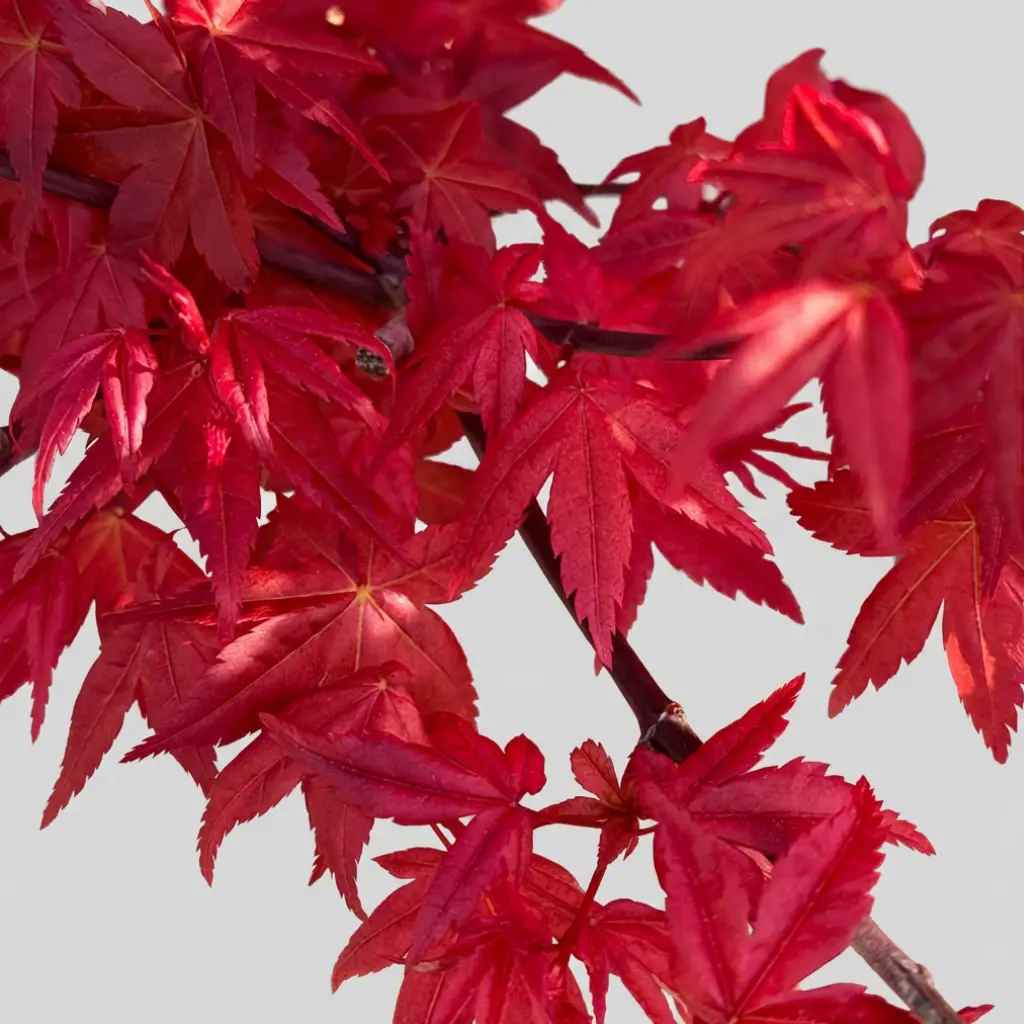
- Spring: Deep red with pink tones — the signature display. New leaves emerge in an intense carmine-red that gradually softens. This is the season that defines the cultivar and the moment most growers wait for.
- Summer: Foliage transitions to deep green. The colour change is complete — summer Deshojo looks nothing like spring Deshojo, which adds seasonal variety to any collection.
- Autumn: Orange to red tones return before leaf drop, closing the cycle with warmth.
The spring flush is Deshojo’s strongest visual asset. It is vivid, reliable and consistent across growing seasons — one of the few cultivar traits that performs as expected year after year.
Growth Behaviour
Deshojo grows vigorously with an upright habit, fast pace, long internodes and large leaves. Adult size in open ground reaches 2 to 4 metres.
For bonsai, this vigour profile means:
- Trunk building is efficient. Deshojo thickens quickly under open growth conditions. Sacrifice branches, ground growing and free extension all work well with this cultivar.
- Internode management matters. Long internodes are the trade-off for vigour. During trunk development, this is acceptable. During refinement, feeding control, pruning timing and light management become critical.
- Energy is strong and directional. Deshojo pushes hard at the apex and outer buds. Without regular rebalancing, lower branches weaken and interior ramification stalls.
This is not a cultivar that sits quietly. It demands active management — but it rewards that management with structural progress that slower cultivars cannot match.
Bark Character
Deshojo develops smooth bark throughout its life. Young branches display red or green tones depending on sun exposure — red on sun-facing sides, green in shadowed areas. With maturity, bark transitions to grey.
The bark is visually clean but understated. Unlike rough bark cultivars such as Arakawa or Allen’s Gold, Deshojo does not develop trunk texture. Winter interest relies entirely on branch structure and silhouette — which makes ramification quality particularly important in the later development stages.
Development Strategy
Deshojo’s vigour is an asset if managed in phases:
Allow free growth. Long internodes are acceptable. Use sacrifice branches to drive caliper increase. Feed with higher nitrogen. The goal is trunk thickness and taper, not refinement.
Begin redirecting energy. Remove sacrifice branches. Establish primary branch positions based on structural design. Start moderating nitrogen to slow extension.
This is where Deshojo’s unique quality emerges. As you build secondary and tertiary branching through repeated pruning cycles, both leaf size and internode length reduce progressively. The tree actively adapts its proportions to the scale you are working toward. This transition is gradual. It cannot be forced by aggressive defoliation or starvation. It happens through consistent, patient cultivation over multiple growing seasons.
Leaf and Internode Reduction
This deserves its own section because it is Deshojo’s most important trait for bonsai.
What makes Deshojo different
Many vigorous cultivars start with large leaves and long internodes — and stay that way regardless of technique. Deshojo is different. With increasing ramification, controlled feeding and appropriate root confinement, Deshojo reduces both leaf size and internode spacing to a degree that makes refined bonsai achievable even from vigorous starting material.
In our experience, the reduction becomes noticeable after two to three years of consistent ramification work. By year four or five, a well-managed Deshojo can display leaf proportions that rival naturally compact cultivars — while retaining the trunk caliper and structural weight that compact cultivars struggle to develop.
This is why Deshojo remains the benchmark. It bridges both worlds: vigour when you need it, refinement when you earn it.
How Deshojo Compares
Deshojo is often compared to two other red-toned Acer palmatum cultivars available at Treevaset:
| Feature | Deshojo | Beni Chidori | Seigen |
|---|---|---|---|
| Leaf size | Large | Medium | Medium |
| Internodes | Long | Medium | Medium |
| Growth habit | Upright, vigorous | Semi-dwarf, upright | Semi-dwarf, upright |
| Spring colour | Deep red, pink tones | Pink to orange | Red-purple |
| Bark | Smooth | Smooth | Smooth, pink-red tones |
| Adult size | 2–4m | 2–4m | 1–2m |
Deshojo vs Beni Chidori
Both are vigorous and upright, but Deshojo’s spring red is deeper and more intense. Beni Chidori starts pink with orange veins — a different colour register entirely. For trunk building followed by refinement, Deshojo’s proven leaf reduction gives it the edge.
Deshojo vs Seigen
Very different cultivars. Seigen is semi-dwarf (1–2m adult), more compact, with a red-purple spring flush. Seigen is naturally suited for shohin without the internode management Deshojo requires. But Seigen cannot build trunk caliper the way Deshojo can.
For a detailed structural comparison of these three cultivars, see our article: Seigen vs Beni Chidori vs Orihime for Bonsai.
Care Considerations
Deshojo care follows standard Acer palmatum guidelines with a few cultivar-specific notes:
- Light: Full morning sun supports colour intensity. Protect from strong afternoon sun in peak summer — Deshojo is sensitive to leaf scorch.
- Watering: Consistent moisture with good drainage. Never let the substrate dry out completely, but avoid waterlogging.
- Feeding: High nitrogen during trunk development phases. Moderate, balanced feeding during refinement. Feeding directly drives internode behaviour — this is where cultivar management happens.
- Soil: Slightly acidic to neutral, free-draining. Akadama-based mix recommended.
- Repotting: Every 2–3 years in early spring before bud break.
- Pruning: Prune after new shoots harden to control internode length. Directional pruning to rebalance energy between strong and weak areas.
- Disease resistance: Deshojo can be prone to powdery mildew in humid summers, which may affect leaf quality. If mildew is a recurring problem in your climate, consider Beni Tsukasa, a refined cousin with the same red spring flush but markedly better mildew resistance.
Frequently Asked Questions
Is Deshojo a good Japanese maple for bonsai beginners?
Deshojo is one of the most forgiving Acer palmatum cultivars for bonsai. Its vigorous growth means it recovers quickly from pruning mistakes, and its responsiveness to techniques like feeding control and directional pruning gives beginners visible feedback. The main challenge is internode management — but this becomes relevant only during refinement, not in early development.
How long does it take for Deshojo leaves to reduce in size?
In our experience, noticeable leaf reduction begins after two to three years of consistent ramification work. By year four or five, a well-managed Deshojo can display leaf proportions approaching those of naturally compact cultivars. The process is gradual — it cannot be accelerated by aggressive defoliation or starvation.
Why does Deshojo lose its red colour in summer?
This is normal and expected. Deshojo’s deep red spring flush is driven by anthocyanin pigments that are strongest in new growth. As leaves mature, chlorophyll takes over and foliage transitions to deep green. The red returns in autumn before leaf drop. This seasonal cycle is one of Deshojo’s most distinctive traits.
Can Deshojo be developed as a shohin bonsai?
Yes, but it requires more internode management than naturally compact cultivars like Koto Hime or Ori Hime. Deshojo’s vigour and large leaves need consistent control through feeding, pruning timing and root confinement. The reward is a shohin with trunk caliper and visual weight that compact cultivars struggle to achieve at small scale.
Explore Deshojo at Treevaset
Deshojo is available as young pre-bonsai at Treevaset — cutting-propagated, non-grafted, and selected for early structural potential. Multiple size options available.
Acer palmatum 'Deshojo' – Japanese Maple for Bonsai
35 €
Sold out — next batch in preparationFor a full comparison of all Acer palmatum cultivars in our collection, see our Acer palmatum cultivar comparison, or start from the species itself with our Japanese maple bonsai care guide.