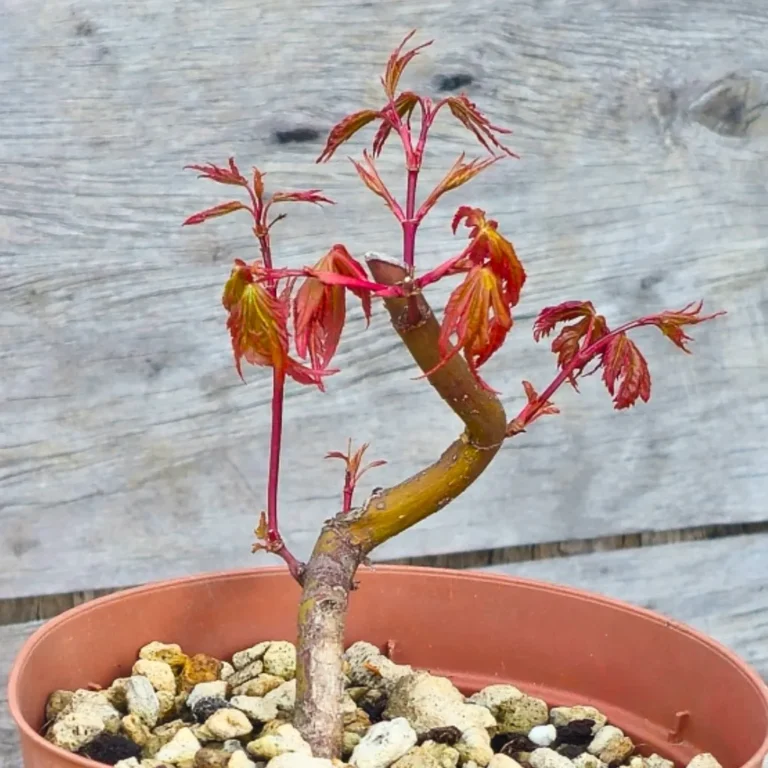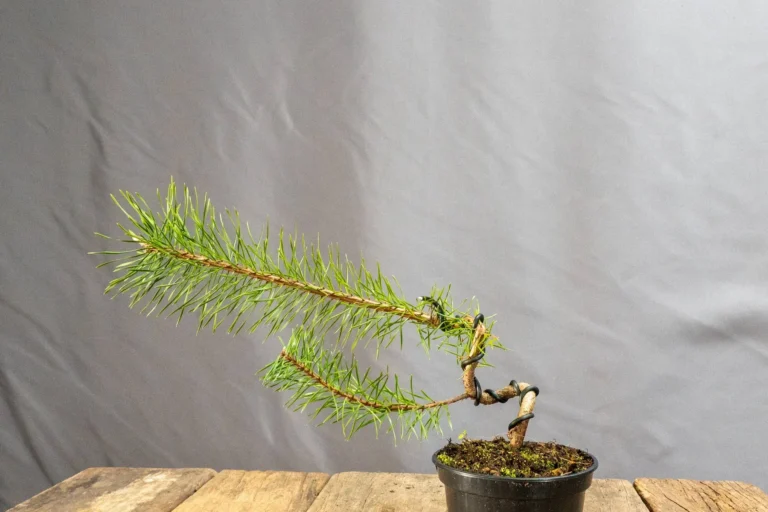
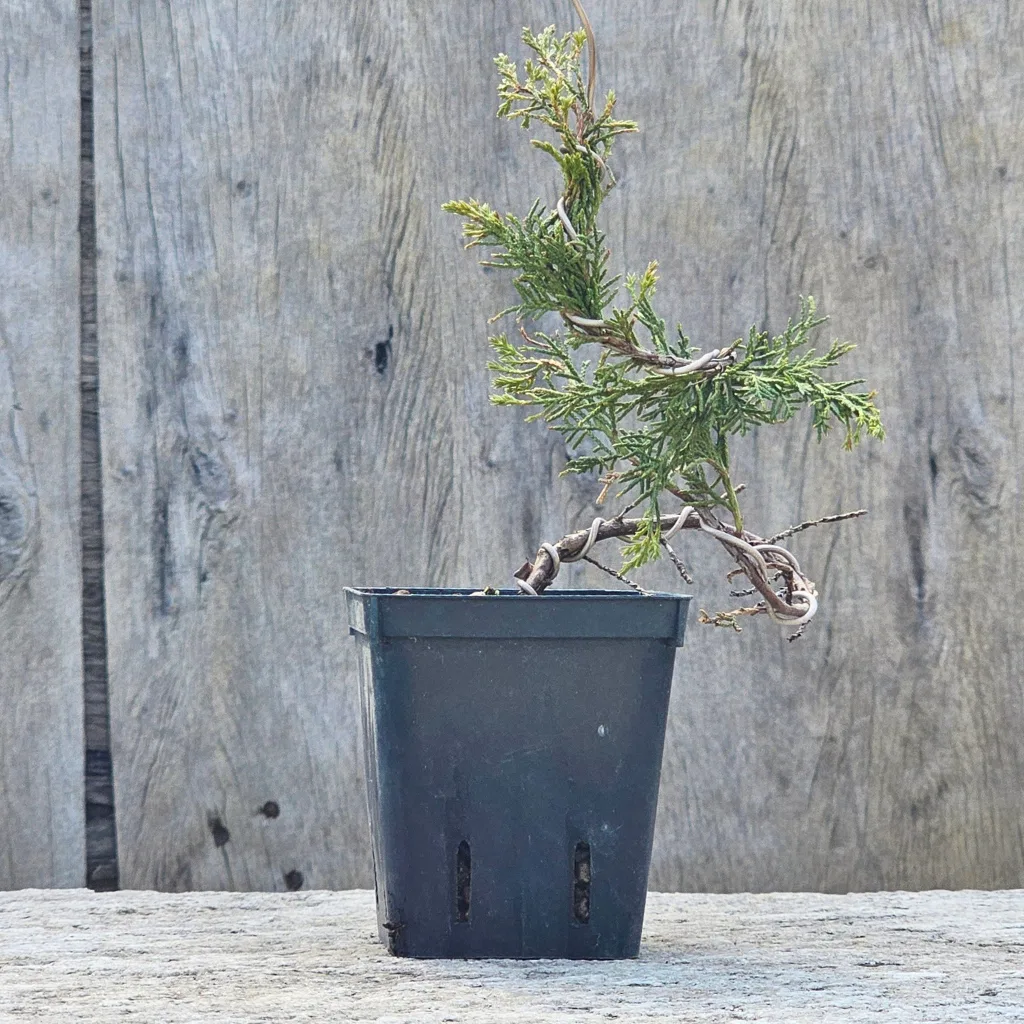
When most people picture a bonsai, the tree in their mind is very often an Itoigawa juniper — they just don’t know its name yet. Among all the varieties of Chinese juniper used for bonsai, Itoigawa is the most refined and the most sought-after, in Japan and everywhere else. The good news: it is also vigorous, forgiving and perfectly happy outdoors in most of Europe, which makes it far easier to care for than its elegant looks suggest.
This guide covers everything a young Itoigawa needs — light, water, feeding, repotting — plus the two things that confuse newcomers most: why the foliage turns bronze in winter, and what pruning a juniper well actually looks like — it is about how you cut, not whether you use scissors.
Itoigawa at a glance
- Species
- Juniperus chinensis ‘Itoigawa’, selected Chinese juniper
- Type
- Evergreen outdoor conifer, fully frost-hardy
- Light
- Full sun, all year round
- Water
- Evenly moist, never waterlogged
- Growth
- Vigorous; back-buds reliably
- Ideal for
- Learning styling · building refined pads
Looking for a tree to start with? See our young Itoigawa pre-bonsai.
What is a shimpaku juniper — and where does Itoigawa fit?
Like all junipers, a young Itoigawa can produce two kinds of foliage: juvenile needles and mature scale foliage. What sets Chinese junipers apart is that their adult foliage is made of soft, fine scales — and this is exactly what the Japanese word shimpaku refers to: the “true junipers” with scale foliage refined enough for bonsai.
Itoigawa is one type of shimpaku, but not the only one. Kishu is another well-known form: more compact, slightly coarser, with a deeper green. What makes Itoigawa the reference among them is the extraordinary fineness of its foliage — scales measuring under a millimetre, in a vivid, bright green. At bonsai scale, that texture is what makes a tree believable: the tiny scales and fine ramification of an Itoigawa canopy read like the crown of a huge, mature tree seen from a distance. No other juniper does this quite as convincingly, which is why Itoigawa has become the most prized juniper for bonsai — arguably the most prized bonsai species altogether.
Where does the name come from?
Itoigawa junipers were originally collected centuries ago in the mountains around Itoigawa, a coastal region of Niigata, Japan (gawa means river). Collectors quickly noticed that junipers from this area were unusually fine and elegant, and the name spread with the trees — first across Japan, then across the world.
No two Itoigawa are exactly alike
Here is something many sellers won’t tell you: Itoigawa is not a single clone. The trees collected in Itoigawa were many different individuals — genetically similar, but not identical. Even today, one Itoigawa may be slightly more vigorous, another slower but finer, with subtle differences in scale size, density and colour.
For everyday care this changes nothing. It matters in one advanced situation: grafting. If you ever graft branches onto an Itoigawa, use material from the same plant (or cuttings taken from it), never from a different Itoigawa — otherwise you can end up with a patchwork tree whose branches differ visibly in colour and texture. It is also a good reason to buy cutting-propagated plants: a cutting is an exact genetic copy of its mother plant, so you know precisely what foliage you are getting.
How much sunlight does my Itoigawa need?
Full sun, all year round. Light is the engine behind the dense, tight foliage this variety is famous for; in shade the pads open up, weaken and become prone to fungal problems. Good air circulation matters just as much — give your juniper an open, airy spot rather than a sheltered corner.
Itoigawa is an outdoor tree, full stop. It needs the seasonal rhythm of a real winter and will decline indoors, even on a bright windowsill.
How often should I water my Itoigawa juniper?
Keep the soil evenly moist but never waterlogged. Junipers tolerate a brief dry spell far better than permanently wet roots, so let the surface of the substrate begin to dry before watering again, then water thoroughly. A free-draining bonsai substrate makes this almost foolproof — slightly acidic to neutral suits Itoigawa well.
Fertilising your Itoigawa
Feed every two weeks during the growing season, from spring to early autumn. Itoigawa is a vigorous variety: fed well and given free growth it thickens noticeably; if you are refining pads instead, ease off the nitrogen and keep up the regular shoot-by-shoot pruning.
Start with a tree that’s ready to train
If you want to put this guide into practice, our young Itoigawa pre-bonsai are propagated from cuttings — so you know exactly which foliage you are getting — and available with a straight or pre-bent trunk, ready for styling.
Itoigawa Juniper (Juniperus chinensis ‘Itoigawa’) – Young Pre-Bonsai
Price range: 12 € through 17 €
In stockWhy is my Itoigawa turning brown in winter?
Don’t panic — this is the question that worries new owners most, and the answer is almost always “your tree is fine”. In late autumn and winter, Itoigawa foliage naturally takes on a bronze, brownish-red tone. It is the tree’s protective response to cold, not a sign of disease or a dying plant, and the vivid green returns in spring. Some growers even count the seasonal colour shift as part of the variety’s charm.
A young plant that was repotted shortly before winter deserves a little protection from prolonged deep frost — an unheated cold frame is plenty. Otherwise, Itoigawa is fully frost-hardy.
Pruning: selective cuts, never a haircut
Here an old myth needs correcting: you may have read that junipers must only be pinched with the fingers, never cut with scissors. Most growers today — Luca included — work the other way round. The bulk of your pruning is done with scissors: reach into the pad and cut the green stems that would otherwise thicken into wood, one shoot at a time. What you must never do, with scissors or with fingers, is trim across the canopy like a hairdresser — cutting blindly through the scale foliage wounds the scales, which die back into browned tips and spoil the pads for months. Pinching the odd shoot tip with your fingers is fine if you are careful, but regular selective scissor work is how Itoigawa builds its famous density.
Structural pruning of branches (with tools, back to wood) is a different matter and Itoigawa handles it very well: this is a variety that responds vigorously to hard pruning when done at the right time.
Wiring and styling: when can I start?
Sooner than you might think. Young Itoigawa branches are green, flexible and elastic — the ideal stage to set movement with light wire, and one of the reasons this juniper is so good to learn on. It tolerates even strong bending remarkably well. Check wire often, though: on a vigorous young plant it bites in quickly.
As the tree matures, Itoigawa pairs beautifully with classic juniper techniques — jin and shari deadwood work — which is why it anchors so many Japanese and European collections.
When should I repot an Itoigawa?
Every two to four years, in early spring just before growth resumes. Young, vigorous plants sit at the shorter end of that range. Use a free-draining substrate, and protect freshly repotted plants from hard frost in their first winter after the move.
Common problems
- Bronze or brownish foliage in winter — normal cold response, see above. Green returns in spring.
- Browned tips after trimming — the canopy was sheared across, wounding the scale foliage. Switch to selective cuts: scissors are fine, aim for the stem rather than through the foliage.
- Weak, open, yellowing growth — almost always light or drainage: more sun, airier substrate.
- Fungal issues — prevention is sun plus airflow; dense shade and stagnant humidity are the enemy.
To see all of this applied to a real tree — an Itoigawa that won a competition in 2014, spent eight years in the ground and is now being brought back to its trunk — follow the second-year styling of that juniper: choosing a new front, sacrificing the two strongest branches, and wiring only the primaries.