Ask ten people to picture a bonsai and most of them will describe a juniper: a twisting trunk, cloud-shaped pads of fine green foliage, perhaps a streak of silvery deadwood. Junipers are the most popular bonsai in the world for good reasons. They are tough, they live happily outdoors in almost all of Europe, they forgive most beginner mistakes, and their young wood bends like wire, which makes them the best species there is for learning to style a tree.
This guide is written from the nursery. It covers the junipers you will actually meet, the care that keeps them dense and healthy, and something you will not find in most care sheets: how a juniper bonsai is built year by year, from a cutting to a tree with a trunk line, and what a plant of two, three, four or five years is for.
Juniper bonsai at a glance
- Species
- Juniperus chinensis and its shimpaku forms, Itoigawa and Kishu
- Type
- Evergreen outdoor conifer, fully frost-hardy
- Light
- Full sun, all year round
- Water
- Evenly moist, never waterlogged
- Growth
- Vigorous; back-buds reliably on healthy trees
- Ideal for
- A first conifer · learning wiring and styling
Is a juniper the right bonsai for you?
Yes, if you can give it a place outdoors. That is the whole test. A juniper wants full sun, fresh air and a real winter; it does not want a windowsill. A sunny balcony, a terrace or a corner of the garden is enough, and in return you get one of the most forgiving trees in bonsai: it tolerates a missed watering better than most species, it shrugs off frost, and it responds to pruning and wiring with vigour.
Where junipers disappoint people is indoors. Most of the small junipers sold as decorative “indoor bonsai” are, in fact, outdoor trees, and they decline slowly in a living room, sometimes staying green for months after they have already died. If you want a tree for the house, choose a species that can live there; if you want a juniper, give it the sky.
Which junipers are used for bonsai?
Junipers come in two kinds of foliage. Needle junipers keep sharp, prickly needles all their life; scale junipers grow soft, fine, overlapping scales once the plant matures. Both are used in bonsai, but almost every famous juniper bonsai you have seen belongs to the second group, and more precisely to one species: Juniperus chinensis, the Chinese juniper.
Shimpaku: Itoigawa and Kishu
In Japan the selected forms of Chinese juniper with foliage refined enough for bonsai are called shimpaku. Two of them matter most. Itoigawa has the finest foliage of all, scales under a millimetre long in a vivid, bright green, which is why it has become the reference juniper for medium and large bonsai. Kishu is denser and slightly coarser, a deeper green with shorter internodes, and naturally compact: pads hold their shape with little effort, which makes it the better choice for small trees, shohin and mame. The care is identical for both. Our Itoigawa care guide goes into the fine detail of this variety and compares the two side by side.
Other junipers you will come across
A few other junipers appear in shops and in collections. Juniperus procumbens ‘Nana’, the Japanese garden juniper, is the needle juniper behind most mass-market “starter bonsai”: hardy and cheap, but prickly to work and often sold, wrongly, as an indoor plant. Juniperus sabina and Juniperus phoenicea are the scale junipers collected from the mountains and coasts of the Mediterranean, the source of many spectacular European yamadori; they are superb material in experienced hands but not something you buy as a young plant. Juniperus communis, the common juniper of Europe, is beautiful in nature and notoriously difficult in a pot, resenting root work. For a first juniper, and for most second and third ones, a cutting-grown Chinese juniper is the sensible choice.
Juniper bonsai care: the essentials
Juniper care is simple once you accept one principle: light builds the tree. Everything below follows from it. The detailed version, with the reasons behind each point, is in the Itoigawa guide; it applies to every Chinese juniper.
Placement and light
Full sun, all year. In shade the pads open up, weaken and invite fungal problems. Good air movement matters as much as light, so prefer an open spot to a sheltered corner against a wall.
Watering and soil
Keep the substrate evenly moist, never soggy. Let the surface begin to dry, then water thoroughly. A free-draining bonsai mix, slightly acidic to neutral, makes this almost impossible to get wrong; garden soil in a bonsai pot is the fastest way to lose a juniper.
Feeding
Every two weeks from spring to early autumn. A well-fed juniper left to grow thickens visibly; when you are refining pads instead, ease off the nitrogen and keep up the shoot-by-shoot pruning.
Winter
Chinese junipers are fully frost-hardy and stay outside. In late autumn the foliage turns bronze to reddish-brown. This is the tree protecting itself from cold, not a disease, and the green returns in spring. Only a plant repotted shortly before winter deserves shelter from prolonged hard frost; an unheated cold frame is plenty.
Repotting
Every two to four years, in early spring just before growth resumes, young vigorous plants at the shorter end of that range. Use a free-draining substrate and keep freshly repotted trees out of hard frost in their first winter.
Pruning a juniper: selective cuts, never a haircut
This is where most young junipers are ruined. The old advice that junipers must only be pinched with the fingers has led many people to trim across the whole canopy, with fingers or with shears, as if cutting a hedge. Cutting blindly through scale foliage wounds the scales; they brown at the tips and the pads look burnt for months.
The nursery method is the opposite: work inside the pad, one shoot at a time, with sharp scissors, removing the green stems that would otherwise thicken into wood and keeping the ones that build the silhouette. Pinching the odd shoot tip with your fingers is fine; shearing is not. Structural pruning, removing whole branches back to wood, is a different operation, and Chinese junipers take it very well when it is done at the right time of year.
How a juniper bonsai is built, year by year
Here is the part most guides skip, because most guides are not written by the person who grows the trees. A juniper bonsai is not styled once; it is built in stages, and the stages have an order that cannot be reversed, because juniper wood only bends while it is young.
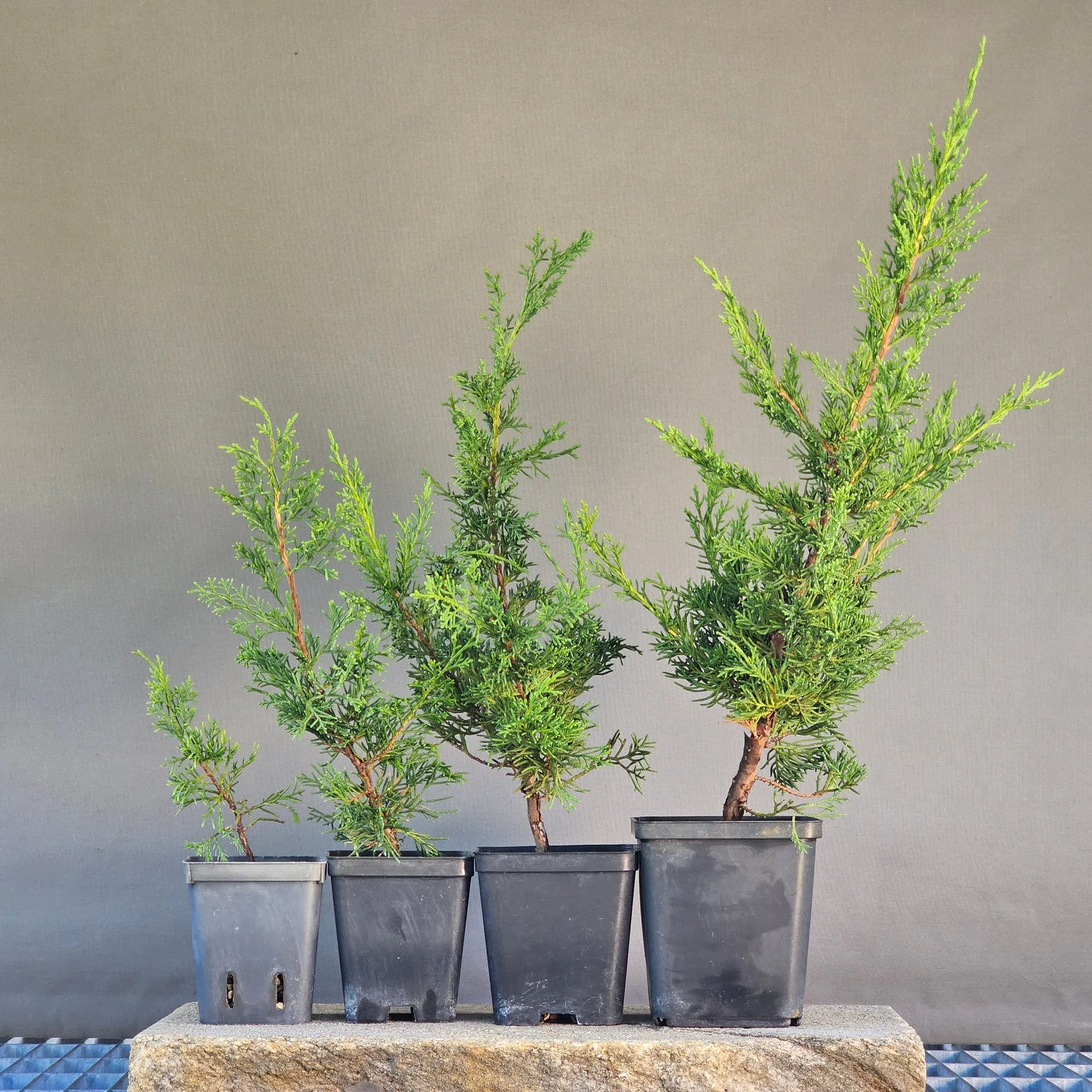
Years one and two: roots and a straight stem
Our junipers start as cuttings, which means each plant is an exact copy of its mother: you know precisely what foliage you are getting. The first two years go into roots and a vigorous, straight stem. We do not bend a two-year-old plant: the wood is too thin to hold a shape and there is nothing to be gained by hurrying.
Years three and four: the trunk line is decided
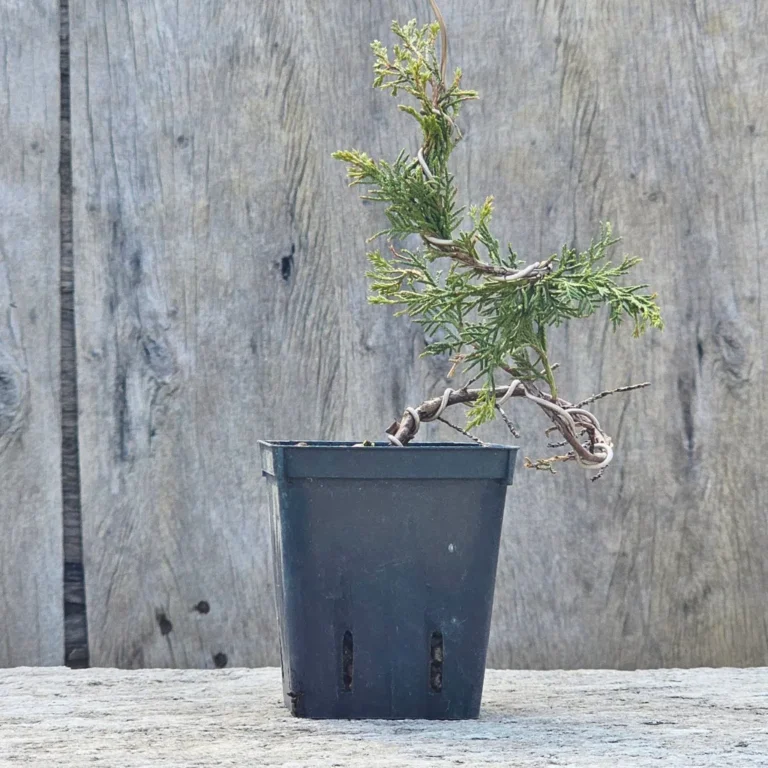
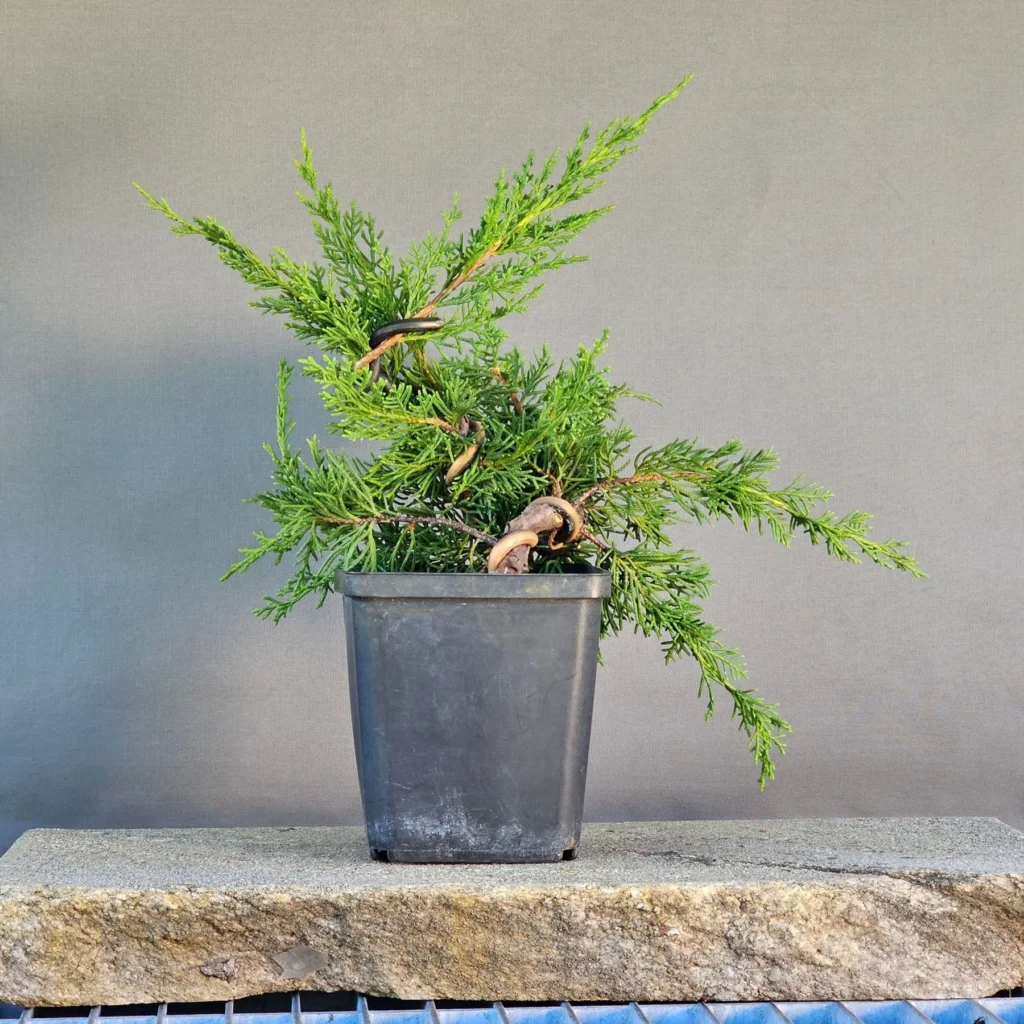
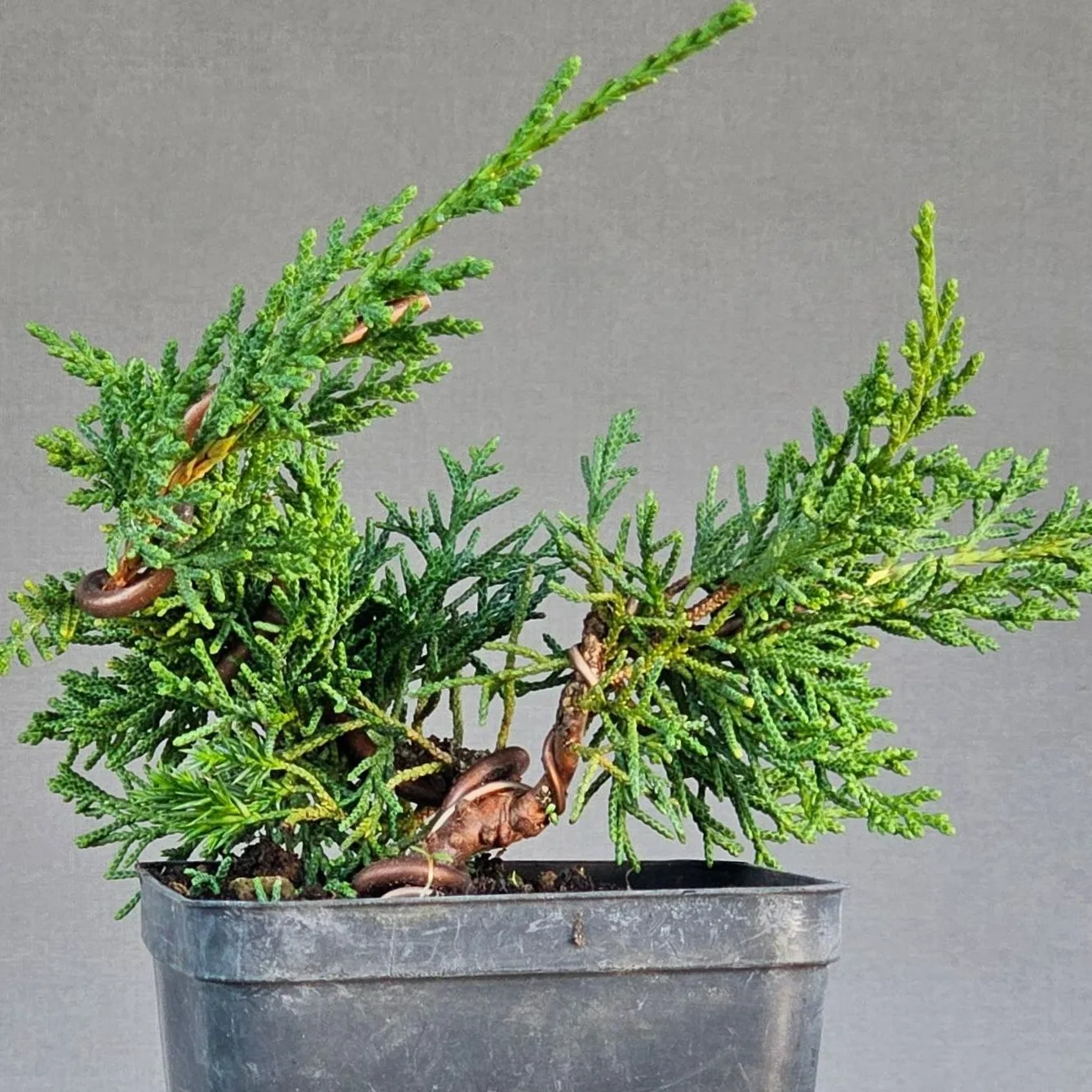
This is the decisive window. The stem is now pencil-thick, still elastic, and it will take a strong, tight bend without breaking. Movement set now, low on the trunk, becomes the line of the finished tree: every nursery-grown bonsai you admire with a dramatic twist in its base got that twist at this age. In the nursery, part of the three- and four-year-old plants are wired and bent, and part are left straight, so you can choose: a bent plant has its first decision already taken; a straight one leaves that decision to you.
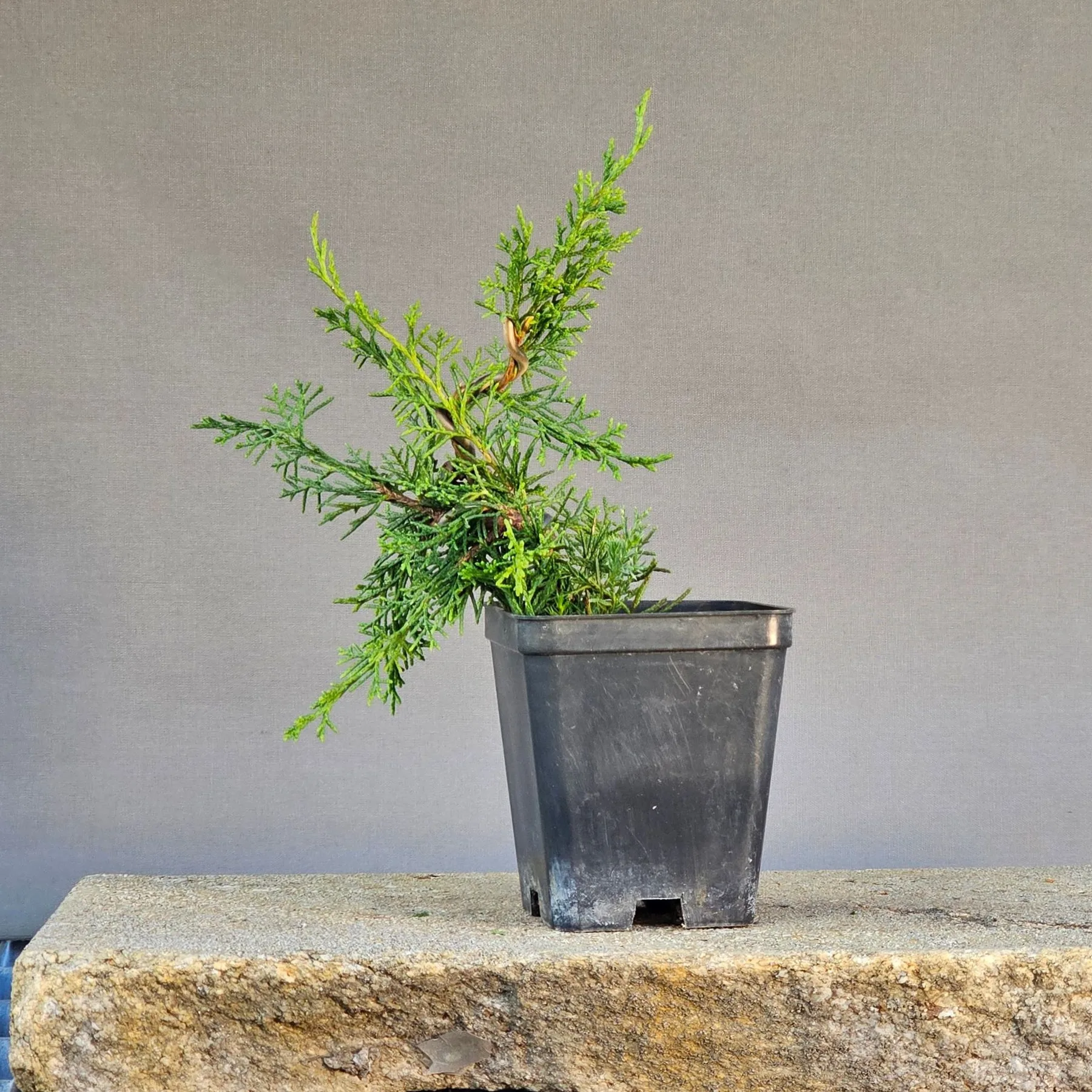
From year five: thickening around the line
Past four years the trunk is too thick for tight bends. It can still be moved a little, but not twisted, so from this age on every plant that leaves the nursery is already bent. From now on the work changes: the tree is fed and grown to put wood on the chosen line, branches are selected, and the pads begin to be built with the selective pruning described above. Deadwood, jin and shari, comes later still, on wood thick enough to carry it.
From the nursery “What we sell as young plants are the same trees we are growing into our specimen bonsai. A pre-bonsai that is not sold simply carries on in the nursery and becomes a specimen. So if you want to know what you can get out of one of our young junipers, look at our finished trees: that is where they are going.” — Luca
To see what the later stages look like on a real tree, watch Luca choose a new front and rebuild the structure of an Itoigawa that won a competition and then spent eight years growing in the ground:
Where to start: which juniper to buy
Choose by age, not by height. Height is almost meaningless in a juniper, because a bent plant is much shorter than a straight one of the same age and the same trunk. What you are paying for is years of growth, and above all the thickness and movement of the trunk.
- Two years, straight: the cheapest way in. A healthy rooted cutting with a thin, flexible stem. Good if you want to do everything yourself, including the first bend in a year or two.
- Three years, straight or bent: the sweet spot for a first juniper. The stem is ready to be wired, or already carries its first curve.
- Four years, straight or bent: a thicker trunk with more presence; the last age at which a straight plant can still be given a strong bend.
- Five years, bent: the line is set and the plant is thickening around it. The closest thing to a bonsai in training that we sell as a young plant.
Prices run from about €12 for a two-year-old to €33 for a five-year-old bent plant. If you want a small tree, start with a Kishu; for a medium or large design, or if that fine, bright foliage is what drew you to junipers, choose Itoigawa. Both are grown from cuttings in our nursery in Italy and shipped across the EU.
- Bonsai
Itoigawa Juniper (Juniperus chinensis ‘Itoigawa’) – Young Pre-Bonsai
Price range: 12 € through 33 € Select options This product has multiple variants. The options may be chosen on the product page - Bonsai
Kishu Juniper (Juniperus chinensis ‘Kishu’) – Young Pre-Bonsai
Price range: 12 € through 25 € Select options This product has multiple variants. The options may be chosen on the product page
Not sure what to look for in a young tree in general? Our guide to choosing a pre-bonsai explains what matters, in order of what is hardest to fix later.
My juniper is turning brown: what is wrong?
Usually nothing. Between late autumn and early spring, Chinese junipers take on a bronze, reddish-brown tone that alarms almost every new owner; it is a normal response to cold, and the vivid green comes back with the first warm weeks. Both Itoigawa and Kishu do it.
Brown foliage is a real problem when it appears in the growing season, or when it is dry and brittle rather than simply discoloured. The usual causes, in order: the pads were sheared across and the wounded tips died back; the substrate stays wet and the roots are suffocating; the tree sits in shade with stagnant air and a fungus has moved in. The fix is always the same combination: sun, air, a draining substrate and selective pruning. A juniper that has gone uniformly dry and crisp, however, is usually already dead, and may have been for weeks; it is the reason junipers kept indoors seem to “die suddenly”.
Frequently asked questions
Can I keep a juniper bonsai indoors?
No. Junipers are outdoor trees and need full sun, fresh air and a cold winter rest. Indoors they weaken over months and eventually die, often while still looking green. A balcony or terrace is enough.
Is a juniper a good bonsai for beginners?
It is one of the best. Chinese junipers are frost-hardy, vigorous, forgiving of the occasional missed watering, and their young wood bends easily, so every basic technique, wiring, pruning and repotting, can be practised on them with real results.
When should I prune a juniper bonsai?
Light selective pruning of green shoots can be done through the growing season, from spring to early autumn, always cutting individual shoots inside the pad rather than shearing across it. Structural pruning of branches is a separate job for a healthy, well-fed tree at the right time of year; the Itoigawa guide covers it.
How do you make a bonsai from a young juniper?
In stages, and in the right order: grow roots and a straight stem for the first two years, set the trunk line with wire at three or four years while the wood is still flexible, then let the tree thicken around that line, select the branches and build the pads with selective pruning. Deadwood work comes last, on thick wood.
How much does a juniper bonsai cost?
A young cutting-grown Chinese juniper costs between about €12 and €33 depending on age and whether the trunk has already been bent. Styled trees with years of work behind them cost from a few hundred euros upwards; the price reflects time, not the species.
Itoigawa or Kishu: which one should I choose?
Kishu for small trees, shohin and mame, thanks to its compact, short-jointed growth; Itoigawa for medium and large trees, for the finest and brightest foliage. Care is the same for both.