When people picture a deciduous bonsai — the fine twigging, the blaze of autumn colour, the delicate hand-sized leaves — the tree in their mind is almost always a Japanese maple. Acer palmatum is the species maple bonsai is built on, and for good reason: five-lobed palmate leaves that reduce beautifully with work, a full year of seasonal change, and a forgiving, responsive nature that makes it one of the best deciduous trees to learn on. This guide covers everything a young Japanese maple bonsai needs through the year — light, water, feeding, pruning, wiring, repotting and winter care — plus the two things that trip up newcomers most: reading the seasons the tree is actually responding to, and protecting the delicate spring foliage from the sun that scorches it.
Japanese maple bonsai at a glance
- Light
- Morning sun, afternoon shade in peak summer
- Water
- Generous in growth, never waterlogged
- Temperature
- Fully frost-hardy; protect the pot in a hard freeze
- Feed
- Regularly, spring → early autumn — dose by goal
- Repot
- Every 2–3 yrs, early spring
- Placement
- Outdoor all year — declines indoors
Acer palmatum — the Japanese (or “mountain”) maple — is a deciduous outdoor tree, vigorous, quick to back-bud, with autumn colour from orange to crimson depending on the cultivar. It suits beginners learning deciduous structure just as well as collectors refining shohin ramification. Not sure which one to grow? Browse the full Acer palmatum cultivar collection.
How much light does a Japanese maple bonsai need?
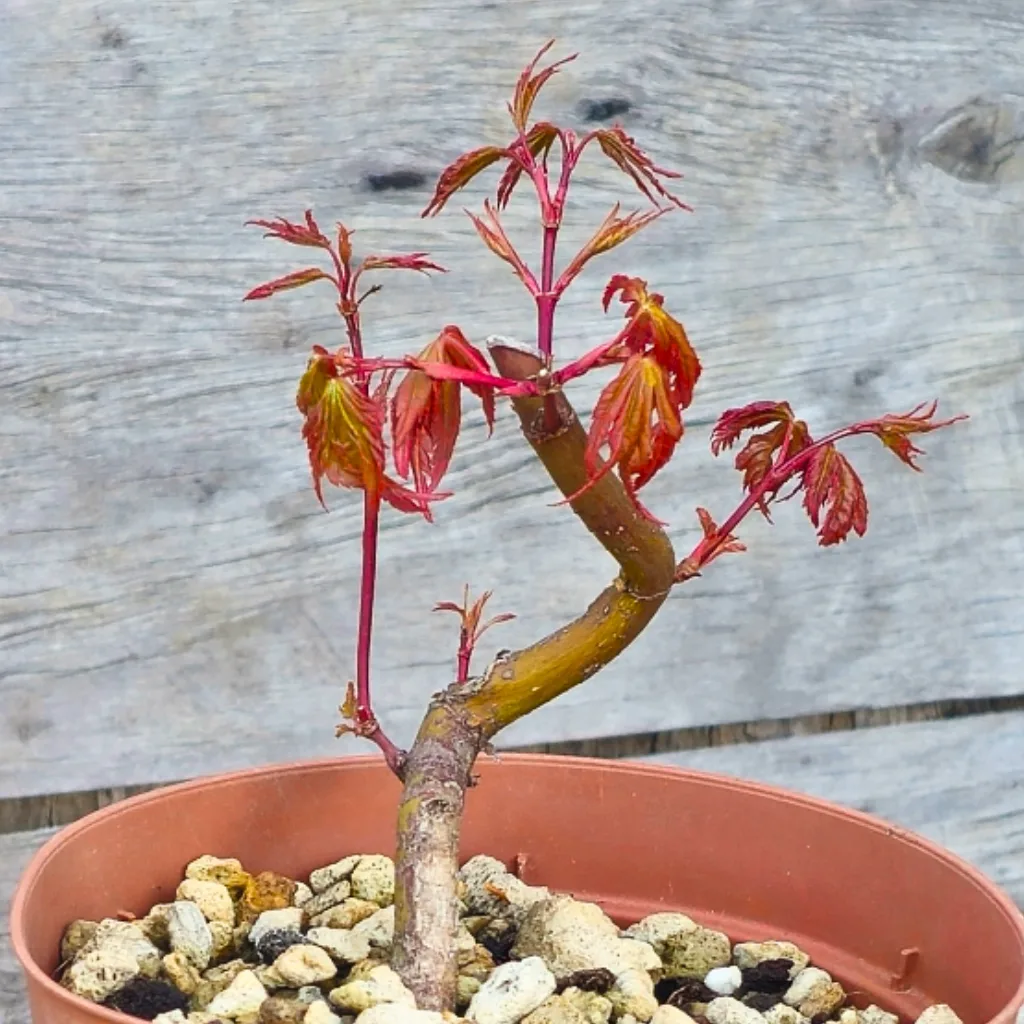
This is where most Japanese maple problems begin. The species wants plenty of light to build strong, compact growth and vivid colour — but morning light, not the fierce afternoon sun of high summer. The soft new leaves of spring, and the fine foliage of dwarf cultivars, scorch easily: brown, crisped leaf margins by July are almost always too much direct afternoon heat, not a disease. The fix is position, not water. Give the tree full sun through spring and autumn, and dappled or afternoon shade during the hottest weeks. Good airflow around the canopy matters just as much — stagnant, humid shade is what invites fungal trouble, so an open, breezy spot beats a sheltered corner. Colour intensity follows light too: the red flush of a Deshojo, the gold of an Allen’s Gold, the emerald of an Ukon all deepen in good morning sun and wash out in heavy shade.
How often should I water a Japanese maple bonsai?
A Japanese maple in full leaf is a thirsty tree. Through the growing season keep the substrate consistently moist but never saturated — maples resent both drought and standing water. In summer heat that can mean watering twice a day for a tree in a small pot; in cool spring and autumn, much less. The reliable method is to check rather than schedule: water thoroughly when the surface of the substrate begins to dry, let the excess drain freely, and never leave the pot standing in a saucer of water. Overwatering is the quieter killer — saturated roots lose oxygen and the tree simply stops developing. A free-draining bonsai substrate makes this almost foolproof.
Feeding your Japanese maple
Feed regularly through the growing season, from the leaves hardening in spring to early autumn. What changes with a maple is how much, according to what you are trying to do: generous feeding while you are building a trunk, moderate feeding while forming branches, and light, controlled feeding during refinement. Nitrogen drives extension — high nitrogen pushes long internodes and big leaves (useful when thickening a trunk, unwanted when refining a fine canopy). Ease off the feed and the tree tightens up: shorter internodes, smaller leaves, denser twigging. Stop feeding as the tree heads into dormancy.
How and when should I prune a Japanese maple bonsai?
Japanese maple builds its structure through selective pruning across the growing season, not a single hard cutback. Once the new spring shoots have extended and hardened slightly, cut back to one or two pairs of leaves to control internode length and encourage the tree to back-bud further inside the canopy — this is how ramification is built. Vigorous cultivars like Deshojo and Arakawa push long growth that needs active, timely management; compact dwarfs like Orihime and Sei Hime ask for small, frequent adjustments rather than one heavy session. Heavier structural cuts are best left to the dormant season, when the tree is leafless and you can read the branch lines clearly — maple takes hard pruning well when it is done at the right time.
Two maple-specific tools worth knowing as the tree gains strength: pinching the tips of new shoots to keep proportions tight, and partial defoliation in early summer on a healthy, established tree to reduce leaf size and let light into the interior. Both are demanding techniques for a tree with reserves to spare — not for a plant in its first season with you.
Wiring: when can I start?
Wire young Japanese maple branches while they are still green and flexible — this is the ideal stage to set movement, and one of the reasons the species is so good to learn styling on. The catch is that maple bark is thin and thickens fast, so wire bites in quickly: check it often through the growing season and remove it before it marks. On fine-leaved and dwarf cultivars the thinnest gauge that will hold the branch is the right one, removed promptly. The best window for structural wiring is autumn, after leaf drop, when the branches are bare and the wood has firmed.
When should I repot a Japanese maple bonsai?
Repot a young Japanese maple every two to three years, in early spring just as the buds begin to swell but before they open. That timing lets the tree recover into the flush of new growth. Use a free-draining, slightly acidic to neutral substrate (around pH 5.5–6.5) with good oxygen retention — the same qualities that make watering forgiving. At each repot, work the roots toward a flat, radial spread: maple builds a beautiful surface nebari, and the early root work is what makes it possible. Protect a freshly repotted tree from hard frost through its first winter after the move.
Autumn colour, dormancy and winter care
The autumn display is half the reason to grow a Japanese maple — orange, gold and crimson depending on the cultivar — and it is strongest on trees given good light and a real drop in temperature. Once the leaves fall the tree is dormant and fully frost-hardy; it needs a genuine winter and must stay outdoors year round (a maple will decline indoors, even on a bright windowsill). Two points of care in the cold: the roots are less hardy than the branches, so in a hard freeze protect the pot — an unheated cold frame or simply plunging the pot is plenty — and watch for late spring frosts, which can burn the first tender leaves. Early-flushing cultivars like Katsura are the most exposed; keep them sheltered until night temperatures settle.
Common problems
- Scorched, browned leaf margins in summer — too much direct afternoon sun; move to morning light with afternoon shade (not a watering problem).
- White powdery film on leaves — powdery mildew, from stagnant humid air; improve airflow and light. Some cultivars (Beni Tsukasa, Beni Chidori) resist it better than others.
- Clusters on soft new shoots — aphids on the spring flush; remove early before they distort the growth.
- Weak, pale, leggy growth — usually too little light or a substrate holding too much water; more sun, airier mix.
- Burnt new leaves in spring — late frost caught the fresh flush; shelter early-flushing trees until the nights are safe.
Watch the Japanese Maple Bonsai Care Tutorial
Which Japanese maple should you start with?
Part of the pleasure of Acer palmatum is the range of cultivars, each with its own character — and they fall into a few natural groups:
- Vigorous trunk-builders — Deshojo (the classic red spring flush, the most popular maple for bonsai) and Arakawa (the original rough-bark maple) grow fast and forgive mistakes, ideal for learning structure.
- Balanced all-rounders — Beni Chidori, Beni Tsukasa, Seigen and Katsura offer medium vigour and spectacular spring colour with manageable growth.
- Refined dwarfs — Orihime, Sei Hime and Koto Hime carry genuinely tiny leaves for shohin and mame work, rewarding patience.
- The green outlier — Ukon, pure vivid emerald where the others go red.
- The species itself — Yamamomiji, the seed-grown mountain maple: faster, tougher and more forgiving than any named cultivar, and the classic tree to learn on.
If you are buying your first maple, a vigorous seed-grown Yamamomiji is the most forgiving place to start — tougher and more tolerant than any named cultivar, and the traditional tree to learn structural work on. When you are ready for a named variety, a Deshojo is the classic gateway into the cultivar collection — we cover it in depth in our complete Deshojo bonsai guide.
Start with a tree that’s ready to train
Every Treevaset Japanese maple is cutting-propagated or seed-grown in our own nursery — never grafted for resale — so what you buy develops true from the roots up. The seed-grown Yamamomiji is the classic tree to learn on, offered in four development stages from a first-wired seedling upward. Or explore the 11 named cultivars.
Japanese Maple Yamamomiji (Acer palmatum) – Young Pre-Bonsai
Price range: 8 € through 40 €
In stockTaking it further
This guide keeps a young Japanese maple healthy through the year. When you want to start turning that young material into a bonsai — building trunk, forming branches, refining ramification through the development stages — see our companion guide: Acer palmatum for bonsai development.