The yew is the conifer for anyone who has already lost a juniper or a pine. It lives in the half-shade that would weaken any pine, it shrugs off every frost a central European winter can produce, and it does something almost no other conifer can: it buds back on old, bare wood. Cut an overlong branch hard, and a few weeks later the new buds sit close to the trunk.
This guide is written from the nursery. It covers the care of the European yew as a bonsai, how and when to prune and wire it, what lies behind the deadwood the yew is famous for, and where its limits are. The worked example is a yew Luca rebuilt completely in autumn 2024 from a dull, formal upright.
Yew bonsai at a glance
- Species
- Taxus baccata, the European yew; the Japanese yew (Taxus cuspidata) is cared for the same way
- Type
- Evergreen conifer, outdoor, fully hardy
- Light
- Partial shade to moderate sun; some sun brings the best colour
- Water
- Keep evenly moist, never waterlogged
- Growth
- Vigorous in bud, slow to thicken; buds back on old wood
- Best for
- Shady balconies · a first conifer · anyone who wants to work deadwood
Is the yew the right bonsai for you?
Yes, if you have a spot outdoors. It asks for little more. Unlike junipers and pines, which need full sun, the yew copes with a north-facing balcony or a courtyard that gets sun for only a few hours a day. By nature it is a tree of the forest understorey and of shaded slopes. Frost does not trouble it: the European yew grows wild as far north as Scandinavia.
Two things are worth knowing first. One, the yew is slow to thicken: it grows vigorously, builds needles and twigs, but the trunk gains very little girth year on year. If you want a thick trunk, you buy it or you plan in decades. Two, every part of the yew except the red flesh of the berry is toxic if eaten. Handling is safe, but children and pets should not nibble it, and you wash your hands after pruning. If what you want is a tree for indoors, the yew is the wrong choice despite its shade tolerance: these species live there better.
European or Japanese yew?
Most yew bonsai in Europe are Taxus baccata, the native species: grown from seed, taken over from gardens or collected as old hedging. From Japan comes Taxus cuspidata, the Japanese yew, with slightly shorter, stiffer needles, common in imported bonsai. For care the difference does not matter: position, water, pruning and winter are the same for both. The European yew has one everyday advantage: it is available everywhere, including as a young seed-grown plant, and its wood is just as hard and durable when it comes to deadwood.
Yew bonsai care: the essentials
Care is plain. Nearly everything that harms a yew comes down to two things: waterlogging, and an unprotected pot in deep frost.
Position and light
Partial shade to moderate sun. A few hours of morning or evening sun give the needles their deep, glossy green and keep growth compact; a tree in a small pot takes the full midday sun of high summer less well, because the roots overheat. In deep shade the yew survives but grows loose, with long internodes.
Water
Evenly moist, never waterlogged. The yew tolerates drying out briefly better than wet feet: roots standing in water rot, and the tree shows it weeks later with yellow, then brown needles. Water thoroughly when the surface starts to dry, and make sure the drainage holes actually drain.
Soil
Free-draining, slightly acidic to neutral. A mix of akadama, pumice and lava works; a share of pine bark or peat keeps the pH slightly acidic, which the yew likes. Garden soil in a bonsai pot is the fastest route to waterlogging.
Feeding
Balanced, from spring to late summer, organic or liquid every two weeks. A young tree being built gets more, to grow; a finished tree that is only being refined gets less nitrogen, so the needles stay short and the pads dense.
Winter
The yew is fully hardy and stays outside. What harms it is not the cold but the combination of a frozen root ball, winter sun and wind: the evergreen needles keep transpiring while the frozen roots cannot replace the water. That is winter desiccation. So in winter you place the tree out of the wind and out of strong sun, ideally with the pot sunk into the ground or in a box of bark mulch. A cold, unheated greenhouse is good; a warm room is not.
Repotting
Every two to three years in spring, just before the buds open. The yew takes root work well, even heavy root work; a healthy tree can lose a third of its root ball and grow normally the same year. After repotting, a few weeks of partial shade and shelter from wind.
Pruning a yew: cutting back into old wood
This is where the yew’s strength lies. Most conifers only bud from wood that still carries needles; cut behind the last green needle and the branch stays bare. Not the yew. It holds dormant buds on old wood, and after a hard cut new shoots break straight from the trunk or from a thick branch. That is why an old hedging yew with a bare interior can be turned into a bonsai, and why a mistake on a yew is almost never final.
Structural pruning, removing whole branches and laying out a new design, is done in early spring before growth starts, or in late summer on a well-fed tree. In late autumn you make no coarse cuts: fresh wounds heal badly before frost. Maintenance pruning in the growing season is easier: as the new shoots extend, shorten them to two to four pairs of needles, shoot by shoot with scissors or by pinching out the soft tip. That is how the tree ramifies and the pads fill in. What you let grow gets long; what you shorten branches.
A tree whose trunk still needs to thicken gets a sacrifice branch: one shoot left to grow free and removed only when the trunk has reached the size you want. On a yew that takes time. It is the conifer where a trunk with character is bought rather than grown over twenty years.
Wiring a yew: flexible wood, but not forever
Yew wood is both hard and elastic; the English longbow was made from it. Young shoots and branches up to finger thickness wire well and hold the bend. Older branches turn brittle: they bend a little and then snap without warning. Big movements are therefore set on young wood, or made with guy wires and patience over months. Wire stays on a yew for a long time because it thickens slowly; even so, check it every month, because wire scars on the smooth bark remain visible once they have cut in.

Deadwood on yew: jin and shari
The most famous yew bonsai are trees with a lot of deadwood: silver-grey, twisting trunks on which a narrow live vein feeds the crown. That is no accident. Yew wood is dense and very durable; once stripped and dried it lasts decades without rotting, and its grain carves and brushes like almost no other. Add the ability to bud from old wood, and you can turn a branch into a jin, strip part of the trunk, and trust the living part to fill the gap with new shoots.
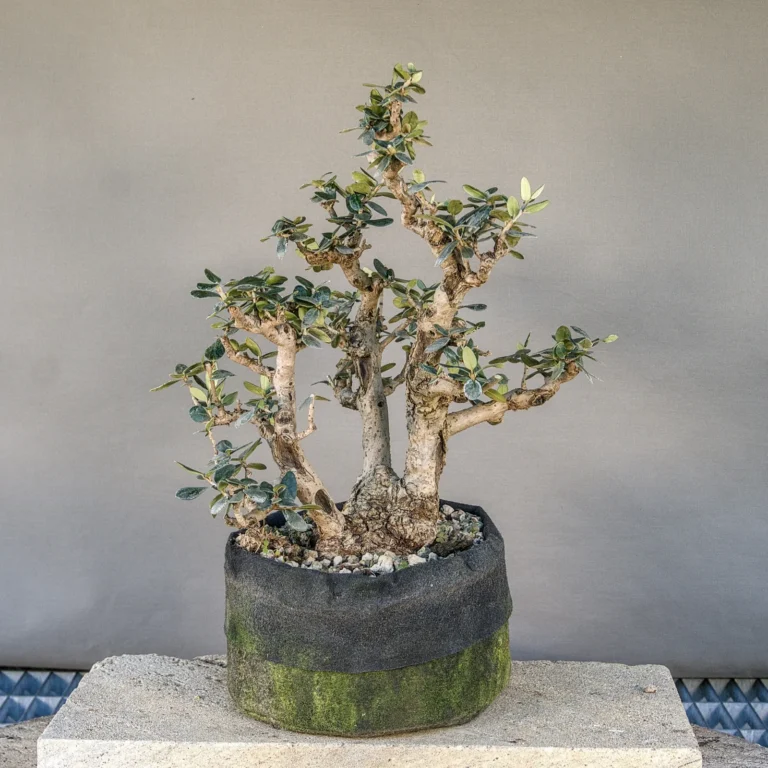
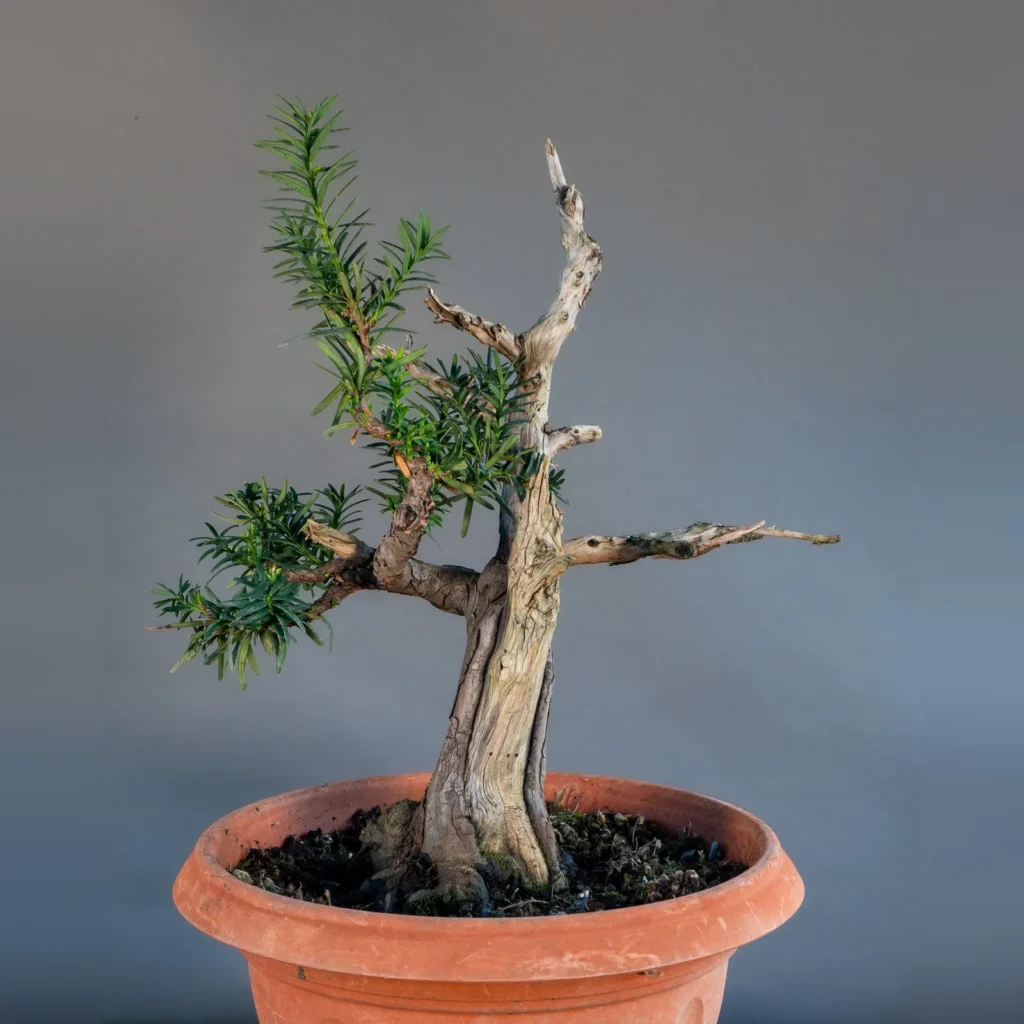
That is how the tree in this guide came about. Luca bought it as a formal upright, rather dull. In autumn 2024 he stripped the old trunk completely and moved the tree to a bigger pot, to build a new trunk out of the last remaining branch. Two years later the structure is there: a live trunk with movement next to the stripped wood of the old one.
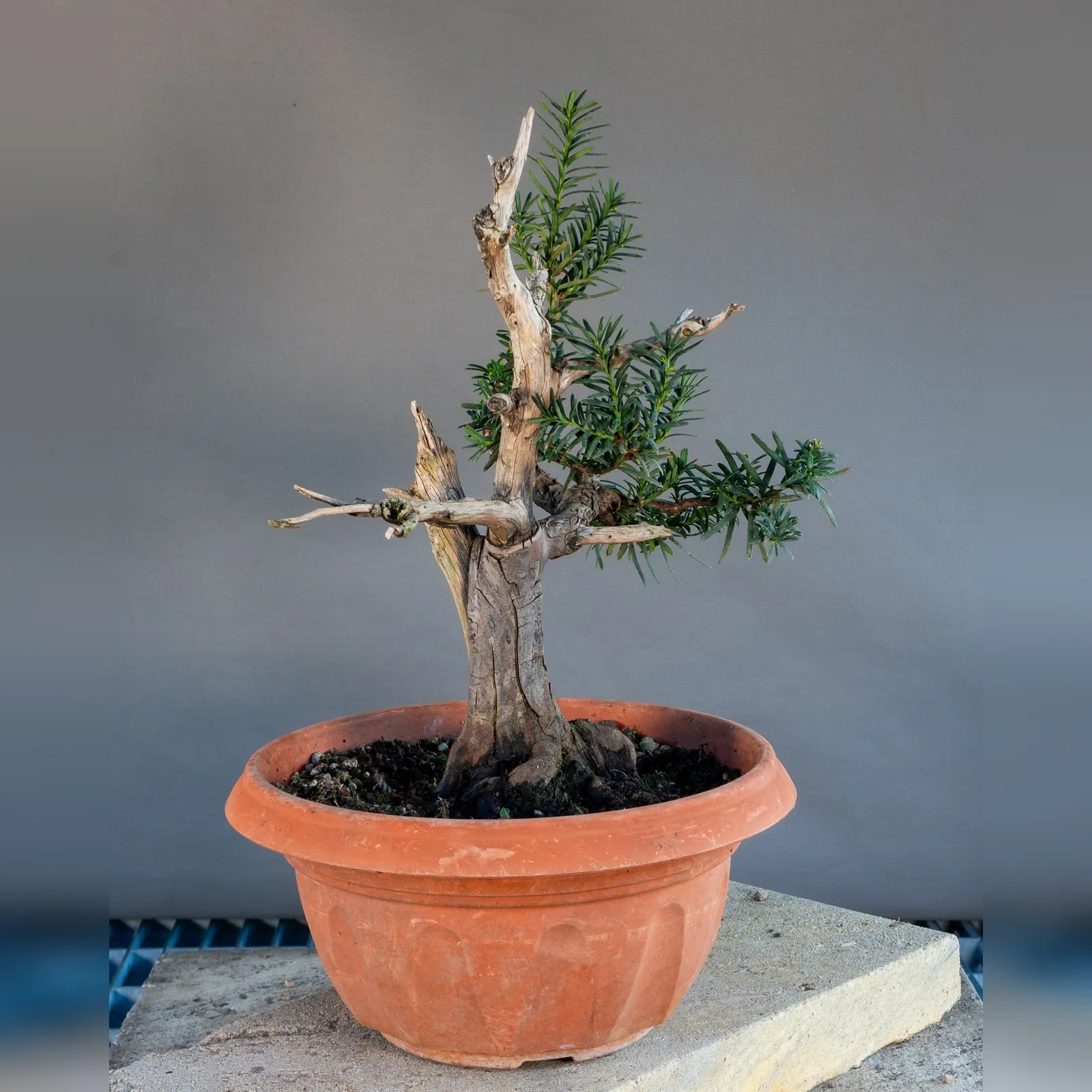
From the nursery “The deadwood has not been carved or treated. I left it that way so the new owner decides its shape. Yew buds back on old wood, so the design can still move a lot.” — Luca
On caring for deadwood: keep it dry. Keep the water stream off the stripped wood when you water, and if it is to stay silver, treat it once a year with diluted lime sulphur after the wood has dried completely. Carve at leisure, with hand tools or a rotary tool, and in several small steps rather than one big one.
How do I get a thick trunk on a yew?
Slowly, to be plain about it. In a pot a yew adds only a few millimetres a year. If you want a trunk with character there are three routes. Plant the tree in the ground for some years and let it grow, with sacrifice branches; take over an old garden tree and reduce it, which works well on yew thanks to its back-budding; or buy a tree whose trunk is already there. Trunk girth is the one point where the yew tests impatient people. Everything else, ramification, pads, deadwood, comes faster on a yew than on most conifers.
Yews from the nursery
We grow the European yew from seed. The young plant is a seedling with dark, glossy needles and a trunk that still bends: the right start if you want to set the first trunk line yourself.
European Yew Bonsai (Taxus baccata) – Young Pre-Bonsai
12 €
In stockFurther along is the yew with deadwood, about twenty years, from this guide: structure set, deadwood raw, ready for a bonsai pot. More outdoor species with years of work in them are among the nursery’s bonsai in training.
Buying a yew bonsai: what to look at
On a young yew, health matters more than shape: dense, dark needles right to the tips, no bare zones at the base, roots not bulging out of the pot. The shape you give it yourself. On an older tree you look at three things. The base of the trunk: it should flare, not sit in the soil like a post. The deadwood, if any: firm and dry, not soft or crumbly. And the live vein: a strip of living bark running without a break from the roots to the crown, with fresh shoots at the top end.
On price: you pay for years, not centimetres. A seedling costs little and is a project for two decades; a tree with a finished trunk and its structure laid out costs hundreds, because on a yew that is exactly what cannot be hurried. What you build on a juniper in five years takes fifteen on a yew. In return you get a wood that lasts centuries.
Frequently Asked Questions
Where should I keep a yew bonsai?
Outdoors, in partial shade to moderate sun. A few hours of morning sun are ideal; avoid full midday sun in high summer with small pots. In winter, out of the wind and without direct sun on the needles.
Can a yew bonsai stay outside in winter?
Yes, it is fully hardy. Protect the pot from freezing through by sinking it into the ground or standing it in mulch, and avoid winter sun and wind on the needles so the tree does not dry out while the roots are frozen.
When do you prune a yew bonsai?
Maintenance pruning during the growing season, as soon as the new shoots extend: shorten to two to four pairs of needles. Structural pruning in early spring before growth or in late summer. No coarse cuts in November.
Does yew bud back on old wood?
Yes, and that is what sets it apart among conifers. After a hard cut new shoots form on bare wood, even straight from the trunk. That is why old hedging yews can be rebuilt into bonsai.
Is yew toxic?
All parts except the red flesh of the berry are toxic if eaten. Handling is safe; wash your hands after pruning and keep the tree away from children and pets.
How do I get a thick trunk on a yew?
Only slowly: a few millimetres a year in a pot. Faster routes are some years in the ground with sacrifice branches, taking over an old garden plant, or buying a tree whose trunk is already there.
When do you repot a yew bonsai?
Every two to three years in spring, just before the buds open. The yew takes root work well. Afterwards, a few weeks of partial shade and shelter from wind.