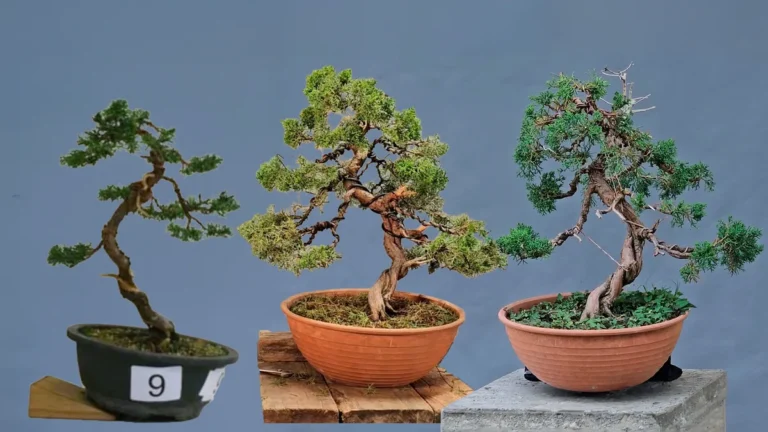
Acer palmatum is one of the most structurally versatile deciduous species used in bonsai development. Its moderate vigor, responsive branching behaviour and cultivar variability make it a long-term framework species rather than a decorative choice. This guide focuses on how Acer palmatum behaves under bonsai cultivation conditions, how it responds to structural interventions, and what to consider when developing Young Pre-Bonsai material over time. The objective is not maintenance. It is controlled development.
New to Japanese maples? Start with our Acer palmatum care guide for the year-round basics — light, watering, feeding, pruning and winter care — then come back here to develop the tree.
Acer palmatum development at a glance
- Vigour
- Moderate, strongly apical — must be rebalanced
- Internodes
- Highly responsive to nitrogen and light
- Back-budding
- Moderate — managed, never assumed
- Leaf reduction
- Progressive, follows ramification
- Bark
- Smooth (rough: Arakawa, Allen’s Gold)
- Styles
- Moyogi, Shakan, Kengai
Species Overview
Native to Japan, Korea and parts of China, Acer palmatum evolved in temperate woodland environments with seasonal variation, filtered light and consistent moisture.
In bonsai cultivation, its behaviour is strongly influenced by:
- Energy distribution patterns
- Internode response to nitrogen levels
- Bud activation under light exposure
- Cultivar-specific genetic traits
Understanding these dynamics is essential for structured development.
Is Acer palmatum the right species for your plans?
Acer palmatum can be highly suitable for bonsai — but suitability is not determined by colour or popularity. It is determined by genetics, growth behaviour and structural response over time, and it must be evaluated at cultivar level, not at species level alone. Many ornamental Japanese maples are bred for landscape aesthetics rather than structural control, and may lack the characteristics required for long-term bonsai refinement.
It is also not a shortcut species. Long-term development requires patience, controlled energy management and structural planning across multiple years: leaf reduction is gradual, branch refinement takes time, and no two trees develop identically. Bonsai development is cumulative — it cannot be accelerated without structural compromise.
If those expectations fit your plans, the rest of this guide covers how the species actually behaves in training — and the cultivar table at the end matches each variety to a development goal.
Growth Behaviour in Bonsai Cultivation
Internode Characteristics
Internode length in Acer palmatum is highly responsive to:
- Nitrogen intensity
- Light exposure
- Vigor concentration at branch tips
Under high nitrogen and strong apical dominance, internodes elongate rapidly. Under controlled feeding and balanced pruning, internodes remain compact and suitable for refinement.
Internode tendency varies drastically between cultivars. Deshojo, Allen’s Gold and Arakawa produce long internodes in vigorous growth (reaching 2–4m, 3–5m and 3–5m in open ground respectively), making them ideal during trunk development but requiring strict control afterwards. At the other extreme, Koto Hime produces very short internodes even with generous feeding — the most compact of all cultivars in our collection. Ori Hime and Sei Hime also stay naturally short, while Seigen, Beni Chidori, Beni Tsukasa, Katsura and Ukon occupy the middle ground with medium, manageable internode spacing.
Young Pre-Bonsai material typically shows longer internodes during trunk development phases. This is structurally acceptable and often desirable before refinement begins.
Vigor Distribution and Apical Dominance
Acer palmatum expresses moderate apical dominance. External buds and upper branches tend to grow more vigorously than internal or lower nodes. Without control, this leads to:
- Energy imbalance
- Weak interior branching
- Loss of ramification potential
Strategic pruning must rebalance energy distribution rather than simply reduce foliage mass.
Back-Budding Tendency
Back-budding capacity is moderate. It depends on:
- Light penetration
- Overall tree health
- Timing of pruning
- Cultivar genetics
In our experience, Deshojo, Beni Chidori and Beni Tsukasa back-bud reliably when healthy and well-lit. Arakawa and Ukon also respond well to cutback, supported by their vigorous and fast growth respectively. Koto Hime produces dense budding along old wood thanks to visible internode separation. Slower-growing dwarfs like Ori Hime and Sei Hime bud more conservatively — structural planning must account for this pace.
Back-budding cannot be assumed. It must be managed.
Leaf Response and Reduction Potential
Natural leaf size varies significantly between cultivars. Ori Hime produces the smallest leaves in our collection — genuinely miniaturised and proportionate to shohin scale without any reduction technique. Koto Hime and Sei Hime follow closely. At the larger end, Deshojo, Allen’s Gold and Arakawa start with large leaves that reduce progressively as ramification increases. Medium-leaved cultivars like Seigen, Beni Chidori, Beni Tsukasa, Katsura and Ukon respond well to standard leaf management techniques.
Leaf reduction is influenced by:
- Controlled feeding
- Root density
- Ramification level
- Energy balance
Excess nitrogen results in oversized leaves and extended internodes. Balanced feeding promotes proportion without forcing reduction prematurely. Seasonal coloration varies by cultivar and climate conditions. Color expression should never be treated as a guaranteed feature.
Each tree is unique.
Bark Development Over Time
Bark character develops gradually and differs between cultivars. Most Acer palmatum produce smooth bark that transitions from green, pink or red tones to grey with maturity. Katsura stands out with yellow, green and orange bark tones that add year-round interest. Seigen develops pink-red tones on younger wood.
Allen’s Gold and Arakawa are the exceptions: both develop rough bark that begins cracking into scales after year four. Allen’s Gold combines this with Katsura-like leaf character, while Arakawa is the original rough bark cultivar with the most pronounced corky texture. For development planning, rough bark means that wire marks become less visible over time as bark texture develops, while smooth-barked cultivars retain wire scarring longer and require more careful timing.
Development Phases in Young Pre-Bonsai
Acer palmatum development follows clear structural phases:
Root health and adaptation to container environment. No refinement attempts.
Vigor is encouraged. Internode length is less critical. Sacrifice branches may be used strategically.
Energy distribution becomes central. Internode control begins. Structural direction is defined.
Ramification density increases. Internodes shorten. Feeding intensity is moderated.
Attempting refinement too early limits long-term structural quality. Young Pre-Bonsai material is intended for these staged decisions.
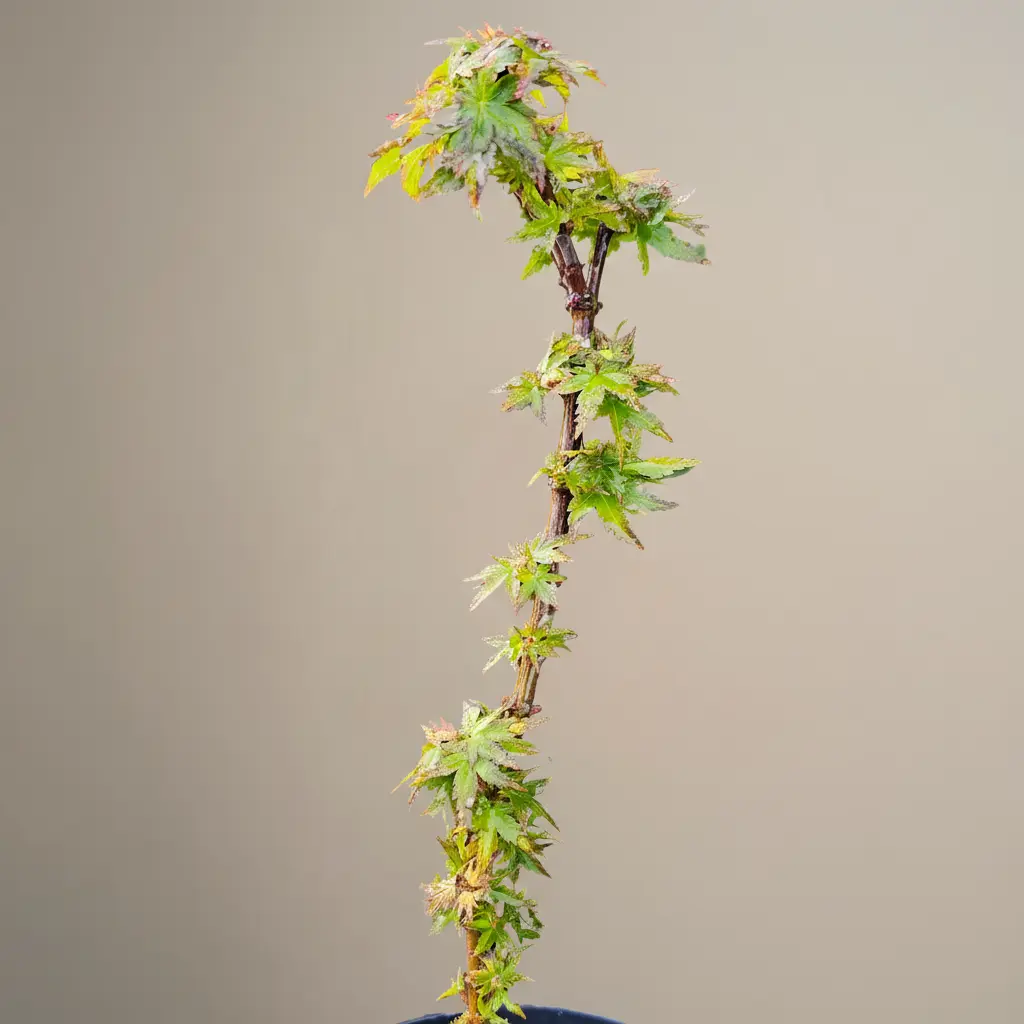
Not all Acer palmatum development starts from a named cultivar. Seed-grown mountain maple (yamamomiji) follows the same staged logic but from the very first year: the seedling is wired early to set a permanent curve at the base — movement that can never be added to an older, stiffer trunk — and its nebari is built from the start, with the roots spread radially during the first re-pottings rather than corrected later. Because every stage is grown in-house rather than imported as finished stock, the same tree can be offered at each development phase. For a worked example of these phases in a single seed-grown tree, see our Acer palmatum Yamamomiji young pre-bonsai.
Start with a tree that’s ready to train
Every stage described in this guide is grown in our own nursery — the seed-grown Yamamomiji is offered at successive development phases, from a first-wired seedling upward, alongside 11 named cultivars selected for structural potential.
Japanese Maple Yamamomiji (Acer palmatum) – Young Pre-Bonsai
Price range: 8 € through 40 €
In stockCultivation Management in Support of Development
Water, light and substrate management exist to support structural goals.
Watering
Consistent moisture without saturation. Overwatering reduces root oxygen and limits development capacity.
Light
Morning sun with protection from intense afternoon heat. Strong airflow reduces fungal pressure.
Substrate
Slightly acidic to neutral (pH 5.5–6.5). High drainage and oxygen retention are essential.
Fertilisation
Nitrogen levels should reflect development phase:
- High nitrogen during trunk development
- Moderate feeding during branch formation
- Controlled feeding during refinement
Fertiliser drives internode behaviour.
Structural Suitability for Bonsai Styles
Acer palmatum adapts well to:
- Informal Upright (Moyogi)
- Slanting (Shakan)
- Cascade (Kengai)
However, each style requires different vigor control strategies. Formal Upright demands stricter internode management. Cascade requires strong energy regulation to prevent upper dominance.
Style choice should reflect structural behaviour, not aesthetic preference alone.
Cultivar Characteristics at a Glance
The table below summarises key growth data for the Acer palmatum cultivars currently available at Treevaset. For detailed descriptions, see our Acer palmatum cultivars.
| Cultivar | Leaf size | Internodes | Growth habit | Spring colour | Bark | Adult size |
|---|---|---|---|---|---|---|
| Orihime | Very small | Short | Dwarf, compact | Light green, bronze margins | Smooth | 1–2m |
| Kotohime | Small | Very short | Dwarf, compact | Green, pink-red margins | Smooth | 1–2m |
| Sei Hime | Small | Short | Dwarf, compact | Yellow-green | Smooth | 1–2m |
| Seigen | Medium | Medium | Semi-dwarf, upright | Red-purple | Smooth | 1–2m |
| Beni Chidori | Medium | Medium | Semi-dwarf, upright | Pink to orange | Smooth | 2–4m |
| Beni Tsukasa | Medium | Medium | Semi-dwarf, upright | Light red, pink tones | Smooth | 2–4m |
| Katsura | Medium | Medium | Upright | Orange to yellow | Smooth | 1–2m |
| Ukon | Medium | Medium | Upright, fast | Emerald green, yellow accents | Smooth | 2–4m |
| Deshojo | Large | Long | Upright, vigorous | Deep red | Smooth | 2–4m |
| Allen’s Gold | Large | Long | Upright, vigorous | Golden-chartreuse, pink margins | Rough | 3–5m |
| Arakawa | Large | Long | Upright, vigorous | Light green, red margins | Rough (corky) | 3–5m |
Understanding development goals before selecting material reduces structural compromise later.
Conclusion
Acer palmatum remains a structural benchmark species in bonsai cultivation. Its adaptability, moderate vigor and cultivar diversity make it suitable for staged development when managed with long-term intent.
The objective is not immediate visual impact. It is progressive structural construction.
For growers seeking development-oriented material, explore our Acer palmatum Young Pre-Bonsai selected for long-term training potential.