Ask any beginner what frightens them most about repotting and the answer is always the same: the roots. Cut too little and the tree never refines; cut too much and, everyone assumes, you kill it. When we filmed the repotting of this twin-trunk hornbeam — a Carpinus betulus collected from the woods — the root pruning was aggressive enough that viewers openly wondered whether the tree would survive it. Five months later, the tree gave its answer.
This article tells the whole story: how the tree was prepared for years before the big cut, what was actually removed on the workbench in January, and what the plant looked like when we came back to it in July. Along the way it answers the real question — not “can you prune bonsai roots?” but how much root pruning a tree can take, and what has to be true before it can take it. Both work sessions are here on video, so nothing has to be taken on faith.
The Tree: A Twin-Trunk Hornbeam from the Woods
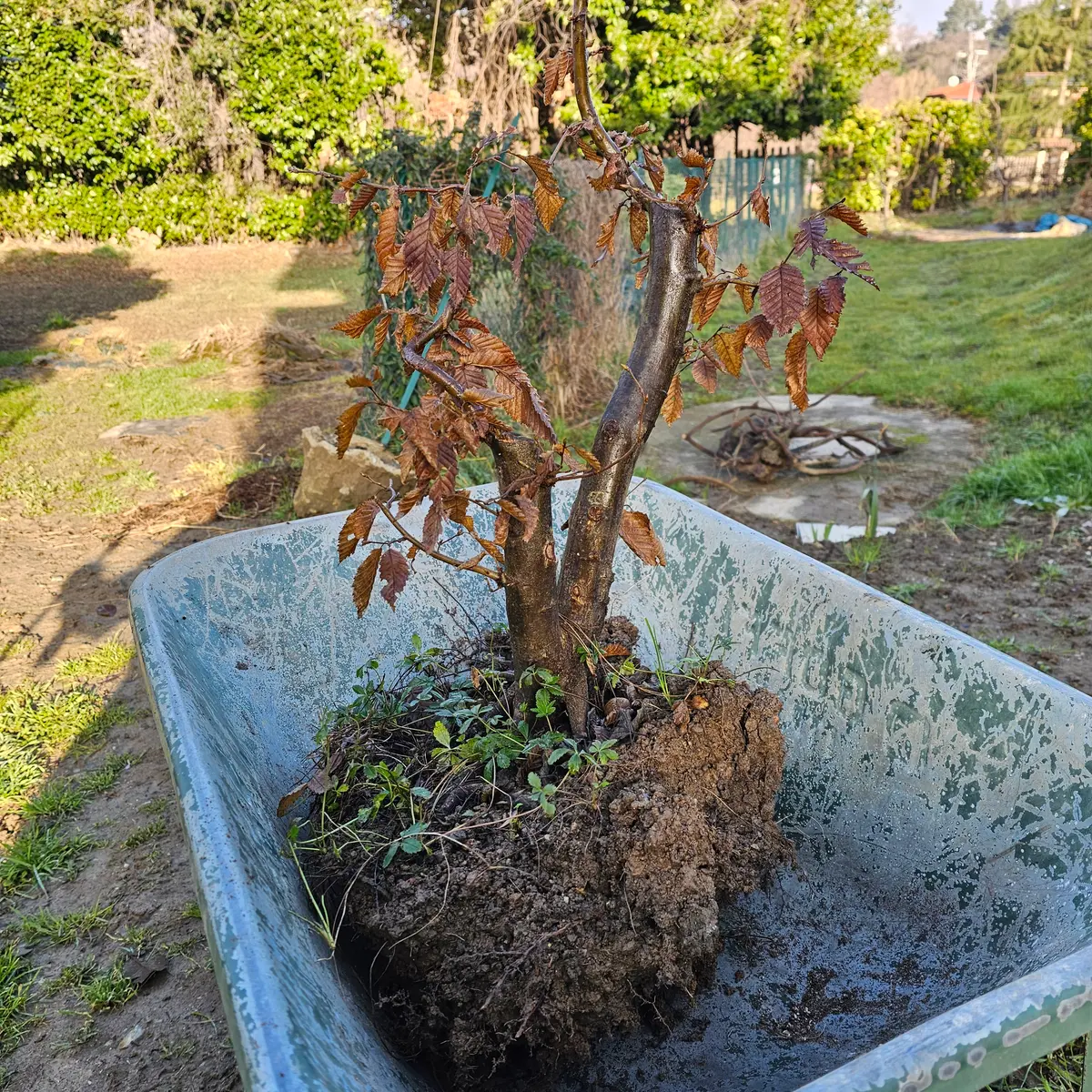
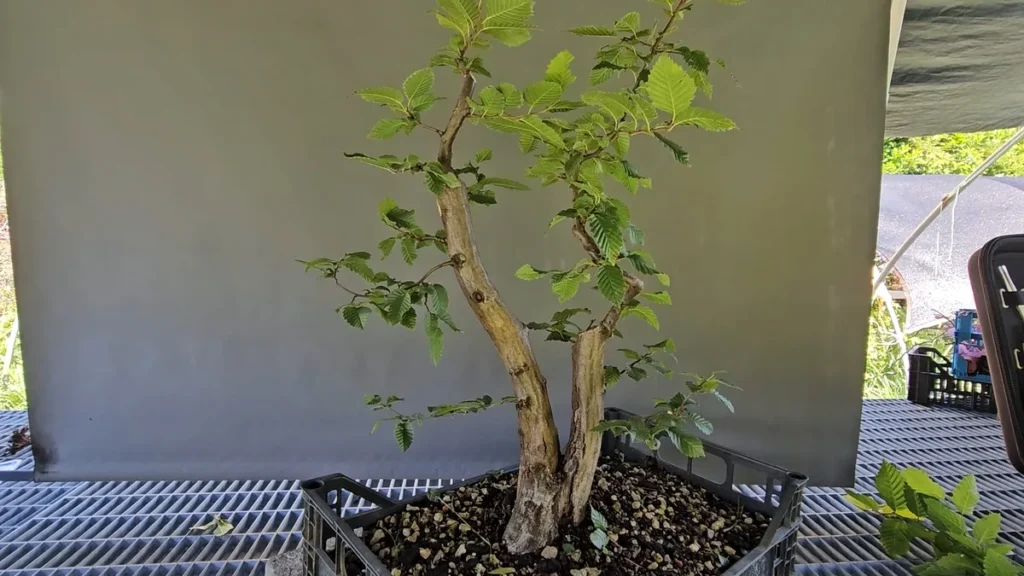
The protagonist is a European hornbeam collected from the wild in 2023 — a father-and-son twin trunk, the classic sokan arrangement, with a base full of movement and the smooth, muscular bark that makes this species so loved for bonsai. It is not the only collected hornbeam on our benches: its companion got a full article of its own about choosing the front and the first styling.
Two decisions at collection time set up everything that followed. First, the heaviest structural cuts — the tap root, the big anchor roots, the upper trunk — were made right there in the woods, so the tree only ever had to survive one major amputation at a time. Second, the tree was replanted in the same clay-heavy field soil it came out of. That soil was objectively poor — heavy, airless, and as we would later see, kind to rot — but keeping it meant the surviving roots were never disturbed twice in one act, and survival was the only priority that day.
Then came the quiet part of the plan: two full years in open ground doing absolutely nothing to it. This is the step impatience skips and regrets. By the time the tree came back to the workbench it had built a network of fine roots close to the base — backup roots, in effect — and those fine roots are precisely what would soon make a radical reduction survivable.
The Radical Repot: From Field Soil to Grow Box
Enjoying this tutorial? Subscribe to our YouTube channel for more bonsai videos →
The session happened at the end of January: still full winter, but with the worst of the night frosts behind us and the buds not yet moving — the window when a hornbeam can lose roots with the least protest. The old clay came off completely, washed away so the roots could be read clearly, and the tree was destined for a mix of pumice, zeolite and lava with a small fraction of peat: everything the field soil was not.
Then the decisions, in strict order. The front was confirmed first, because a nebari only makes sense relative to a viewing side. Only then were the roots judged: the ones that would define the nebari stayed; a thick root diving straight down was removed in favour of a neighbour with more movement and grace; roots that had died or rotted in the airless clay were carved back to sound wood. Some cuts needed the saw. One oversized root earned a stay of execution — still too precious to remove while the fine roots establish, but already sentenced for a future session. The eliminations were consistent with one rule: a big root may only go if finer roots nearby can take over its work — and after two years in the ground, they could.
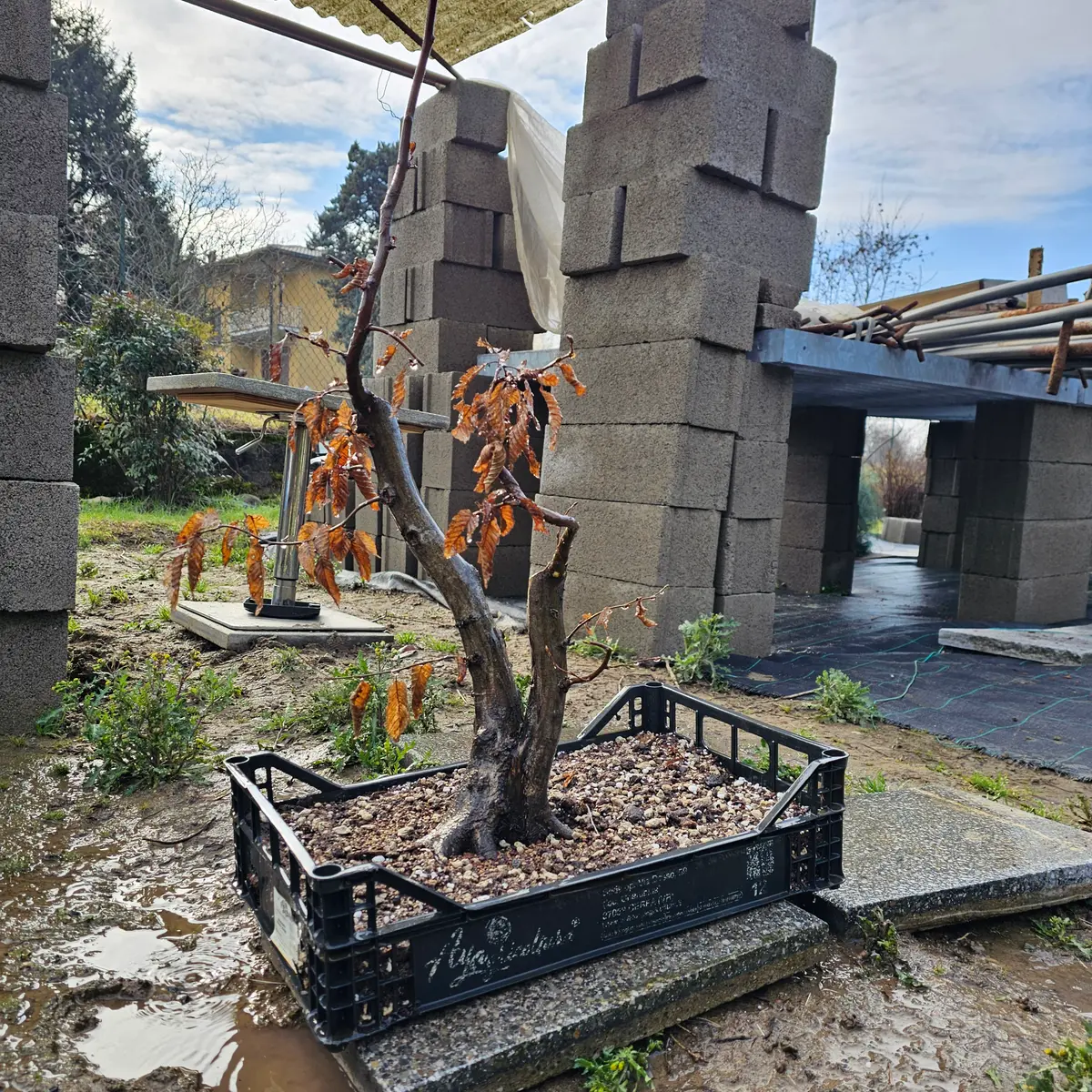
The container tells you this is cultivation, not decoration: an ordinary plastic crate with mesh over its openings. The tree was wired down to it hard, because a tree that rocks in its box keeps snapping its newest roots exactly when it can least afford to. And it was planted deliberately deep, with only a shallow layer of substrate beneath the base — a low position that encourages the trunk itself to push new roots, exactly where a future nebari wants them.
How Much Root Can You Actually Remove?
The real answer is that the question is framed wrong. There is no universal percentage, and chasing one misses what actually decides survival. What this hornbeam demonstrates is that the safe amount is not a number — it is a set of conditions:
- Stage the reduction across years. This tree could take a radical pruning in January only because the biggest cuts had already happened at collection, two years earlier. No single session ever removed everything at once.
- Fine roots near the trunk are the currency. The whole point of the two years in field soil was to grow fine feeder roots close to the base. You can remove impressive amounts of heavy root when fine roots stand ready to take over; without them, even a modest cut is a gamble.
- Work in the dormant window. Late winter, hard frosts past, buds still closed — the tree meets spring with its wounds already made and its energy intact.
- Let vigour set the calendar. A tree that is merely surviving gets left alone. This one had earned its session, and even so, everything after it was decided by watching the response, not by following a schedule.
- Aftercare starts on the workbench. The tie-down, the deep planting and the free-draining mix are not afterthoughts; they are as much a part of the root pruning as the scissors.
If you are still deciding whether your tree should be repotted at all this year, start with our guide on when to repot a bonsai — and when to avoid it; this article picks up where that one ends, at the point where the root ball is in your hands.
Five Months Later: Did It Survive?
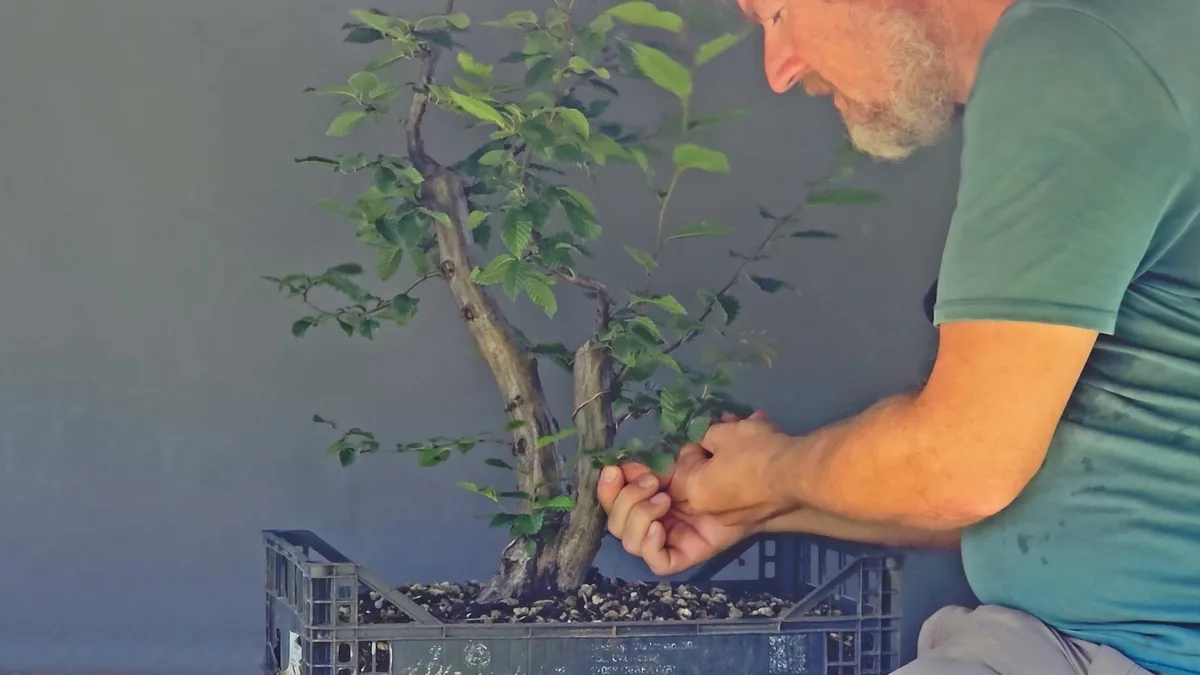
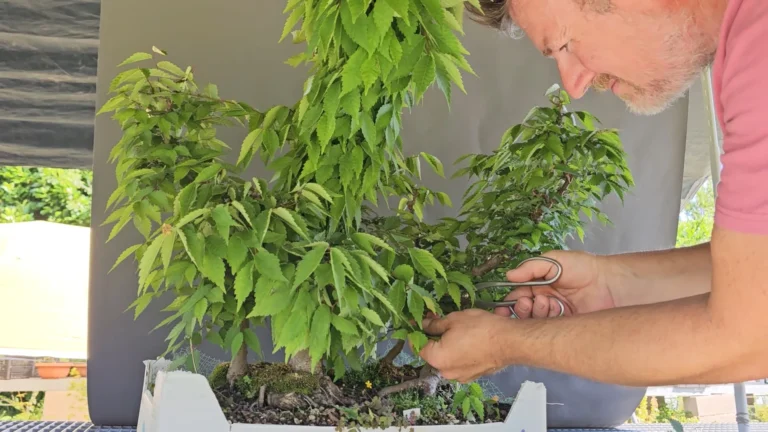
In mid-July the verdict was unambiguous: the tree is in excellent health, the roots are colonising the crate, and the trunk carries a respectable crop of new shoots. Not explosive growth — a root-pruned tree pushes gently in its first season, and we knew it would — but healthy, well-distributed growth on both trunks. The doubters in the comments were answered by the tree itself.
The July session shows what a sensible follow-up looks like: light, precise, and nothing like the January intervention. The wire that had set the primary structure came off — it had stayed on for months without biting, precisely because the tree was growing at reduced speed. Shoots sprouting uselessly at the base, on the insides of curves, or in redundant clusters were cleared. The old scars got attention: the swelling around one former branch was carved back so the callus can roll flat and natural, then sealed with cut paste. And both trunks — father and son — received a first apex change, made now so the new wounds enjoy the second half of the season to begin callusing. A rough wiring of the primary branches closed the session, with the chosen apices set bolt upright: a vertical shoot pulls energy, and energy is what closes wounds.
Aftercare: What Happens After a Heavy Root Pruning
The work that saves a hard-pruned tree mostly happens after the tools are down. This is the regime that carried our hornbeam from January to July:
- Water in well, then protect. Straight after the repot the tree went to a sheltered, shaded position — no full sun — and stayed there until April–May.
- Feed by response, not by schedule. Fertiliser and full sun were only introduced once the tree showed vigour, at the dose its growth justified.
- Keep the rest of the year light. After a radical root reduction, everything else waits or stays minimal: no root work, restrained pruning, structure only refined once health is proven.
- Then leave the roots alone. The tree will not be repotted this winter. The roots get roughly two undisturbed years to colonise the box; the next repot is planned for the winter of 2027–28, when the fine root system this whole operation was designed to build gets harvested.
If yamadori aftercare had a motto, it would be this: one big intervention, then patience dressed up as small jobs. Everything that comes before that intervention — what to dig, when, and how we handle collection day — is in our yamadori bonsai guide.
What’s Next for This Tree
The plan for the rest of the year is deliberately modest. If the tree pushes strongly in late summer, the pruning may be lightly refined; after leaf fall, with the structure finally readable, the branch selection will be revisited and the energy balance corrected. No repot this winter. And in the winter of 2027–28, the box comes off and we find out what two more years of undisturbed root growth have built. This page is the tree’s diary — each new work session on this hornbeam will be added here.
Working on a collected tree of your own and unsure how far to push it? Our one-to-one bonsai consultation exists for exactly this kind of decision.
Key Takeaways
- There is no safe universal percentage for root pruning — survivability is built, in stages, over years.
- Make the heaviest cuts at collection, then let the tree grow undisturbed until fine roots appear near the base.
- A big root may only be removed when finer roots nearby can take over its function.
- Work at the end of dormancy, once hard frosts have passed and before the buds move.
- Tie the tree down immovably and plant it deep in a free-draining mix — aftercare starts on the workbench.
- Shade until mid-spring, feed by response, and keep every other intervention that year light.
- After a heavy root pruning, give the roots about two undisturbed years before the next repot.
Root pruning maintains a root base that already exists. If what you want is to create one — flat, radial, at a single height — that project starts much earlier: see building bonsai nebari from day one.
Frequently Asked Questions
How much of a bonsai’s roots can you safely remove?
There is no universal percentage, and any number you read is a guess about a tree its author has never seen. What decides survival is preparation: whether the reduction is staged across sessions, whether fine feeder roots exist near the trunk to take over from the heavy roots you remove, whether the work happens in the dormant window, and whether the tree was vigorous going in. This hornbeam tolerated a radical reduction because its biggest cuts had been made at collection two years earlier and it had spent those years growing fine backup roots close to the base.
Will a tree survive an extreme root pruning?
It can — this hornbeam did, and the five-month update shows it colonising its grow box with healthy shoots on both trunks. But survival was engineered, not lucky: staged cuts, a dormant-season window, a firm tie-down so new roots could not be shaken loose, deep planting in a free-draining substrate, shade until mid-spring, and a season in which every other intervention stayed deliberately light. Remove the same amount of root without those conditions and the outcome can be very different.
When is the best time to root-prune a bonsai?
At the end of dormancy: late winter, once the hardest night frosts have passed but before the buds begin to move. Worked in this window, the tree meets spring with its wounds already made and its full reserves available for the response. Our hornbeam was root-pruned at the end of January; by mid-July the box was filling with new roots. The wrong moments are just as clear — mid-growth, high summer, or stacked on top of another major intervention in the same season.
What is the correct aftercare after heavy root pruning?
Water thoroughly, then place the tree in shelter and shade — no full sun — until mid-spring. Introduce fertiliser and sun gradually, guided by the vigour the tree actually shows rather than by the calendar. Keep it firmly fixed in its container so wind cannot tear the new roots, and resist the urge to keep working on it: after a radical root session, the rest of the year should hold nothing heavier than shoot selection and wound care.
How long after a hard root pruning until the next repot?
Leave the roots undisturbed for roughly two years. The point of a hard reduction is to trigger fine, dense rooting close to the trunk, and that network needs uninterrupted time to build. Our hornbeam, boxed in January 2026, will not be repotted in the coming winter at all — the next repot is planned for the winter of 2027–28, when the results of the whole operation get their first proper look.