The olive is the tree of the Mediterranean, and as a bonsai it keeps all of it: the pale bark that furrows with age, the small leathery leaves, a trunk that looks a hundred years old at thirty. It is also one of the most widely sold “bonsai” in Europe, and one of the most mistreated: it ends up in a living room, gets watered every day and dies quietly, often while still green.
This guide is written from the nursery. It covers how to keep an olive or wild olive bonsai alive and healthy, when and how to prune it, where it should spend the winter, and one thing most care sheets leave out: how to correct the nebari of an old olive, with the example of a thirty-year-old wild olive Luca repotted in February 2026.
Olive bonsai at a glance
- Species
- Olea europaea; for bonsai almost always the wild form, var. sylvestris (olivastro)
- Type
- Evergreen broadleaf, outdoor, Mediterranean
- Light
- Full sun, all year
- Water
- Let the top of the soil dry between waterings; never waterlogged
- Winter
- Outside, sheltered from hard frost: above about −5 °C, never in a heated room
- Best for
- Anyone with a sunny balcony or terrace · anyone who wants a tree that looks old early
Is the olive the right bonsai for you?
Yes, if it can live outdoors in the sun. That is the first question, before price and before shape. An olive wants direct light for many hours a day and moving air; on an indoor windowsill it stretches, drops its old leaves without making new ones and is finished within a couple of years. A south-facing balcony, a terrace or a corner of the garden is the right place: anywhere south of the Alps without a second thought, and north of them too with a winter shelter.
In return it is one of the toughest trees in bonsai. It takes heat, less-than-perfect soil, a missed watering, hard cuts. It buds back on old wood, so a wrong branch can be removed and rebuilt. And it ages well: the bark furrows and twists on its own, with no work from you. If what you want is a tree for indoors, pick a species that can live there; the olive is not one of them.
Olive or wild olive: what is the difference?
They are the same species, Olea europaea. The cultivated olive (var. europaea) is the tree of the groves: selected for its fruit, with larger leaves and longer internodes. The wild olive (var. sylvestris, olivastro in Italian) grows in the scrub, often browsed by goats and bent by the wind, and has smaller leaves, denser branching and bark that twists earlier. For bonsai the wild form wins almost every time: the small leaves stay in proportion on a thirty-centimetre tree, and fine ramification builds in fewer years. Cultivated olives are used too, mostly for large trees: pruning reduces the leaves, but never to the fineness of a wild olive.
One clarification about the large “bonsai” olives sold by garden centres in tubs, a metre or more tall with a clipped ball of a crown: those are garden olives shaped to look like a bonsai. Fine plants, but a different thing, with different care and a different price. Here we are talking about trees in bonsai pots, twenty to sixty centimetres tall.
Olive bonsai care: the essentials
Olive care turns on two things: sun and drainage. Nearly every problem we see on customers’ olives comes from one of the two being missing.
Position and light
Full sun, March to October, no exceptions. In the hottest weeks of summer an olive in a small pot appreciates some shade in the middle of the day, not for the leaves but for the roots, which reach high temperatures in a dark pot under July sun. Air matters as much as light: a closed corner against a wall, with no movement, invites scale insects.
Water
Water thoroughly when the top of the soil starts to dry, then wait. An olive copes far better with a short drought than with a pot that is always wet: roots sitting in stagnant water rot, and the tree answers by dropping leaves, which is the opposite of what the owner assumes when they see it suffer and water more. In summer, in full sun, that can mean every day; in winter, under shelter, once every two weeks.
Soil
Very free-draining. Pumice and lava work well, with a share of akadama if you want to hold a little more water. The olive is undemanding about soil and tolerates fairly alkaline ground; what it does not tolerate is the compacted clay found in so many nursery pots.
From the nursery “Olives do not need a refined substrate: they are Mediterranean plants and cope well even with fairly alkaline soil. The wild olive I repotted was in clay and gravel, a poorly aerated mix, and still the fine roots were there. On a tree this far along I add a lot of pumice, zeolite and a little akadama, with very little peat: I do not want vigorous shoots, I want roots that breathe.” — Luca
Feeding
From spring to early autumn, with a slow-release organic fertiliser or a balanced liquid feed every two weeks. A tree still being built is fed more, to grow; a mature tree that only needs refining gets less nitrogen, because over-vigorous shoots stretch the internodes and enlarge the leaves.
Winter
The olive is a Mediterranean tree, and in a pot it has no soil mass to protect its roots. Down to a few degrees below zero it is fine; hard, prolonged frost, below about −5 °C, damages first the roots and then the branches. The right winter place is cold but sheltered: a cold greenhouse, a garage with a window, an unheated stairwell. Not the living room. The olive needs its winter rest, and the dry warmth of a house at twenty degrees in January does it more harm than a night at −3.
Repotting
Every two to three years, in late spring, once nights are warm and the tree is in full growth: an olive heals and regrows roots in warmth, not in the cold of February like deciduous broadleaves. Use a shallow, wide pot, which pushes the roots outwards, and after heavy root work keep the tree out of wind and direct sun until it starts moving again.
In the video further down the repot is in February, as the warmth was returning. After the work the tree stayed in a plastic bag until April-May, opened a little at a time as the shoots lengthened, and then went back into full sun, as is natural for an olive.
Pruning an olive bonsai: back to the first pair of leaves
An olive is built with scissors, not wire. The branches lignify fast and the wood becomes stiff and brittle: wire is only useful on the current year’s shoots, and even there it comes off early because it marks the bark. Everything else, the direction of the branches, the density of the crown, the small leaves, comes from pruning.
The rule we use at the nursery is a single one, and it holds for the whole growing season: when a new shoot has made four to six pairs of leaves, cut it back to the first pair. From that pair two shoots start, and those in turn are cut back to the first pair. That is how fine ramification builds up, season after season, and how the leaves stay small. On a tree whose structure is set nothing is allowed to run; on a tree that still needs a thicker trunk, one sacrifice shoot is left to grow free and the others are cut.
Structural pruning, removing whole branches or shortening the trunk hard, is done in spring, when the tree has the strength to respond. An olive buds back from old wood generously: a stub cut in March is covered in shoots by summer, and you choose among them. It is also why large wild olives collected from the field can be reduced to a bare trunk and rebuilt from nothing.
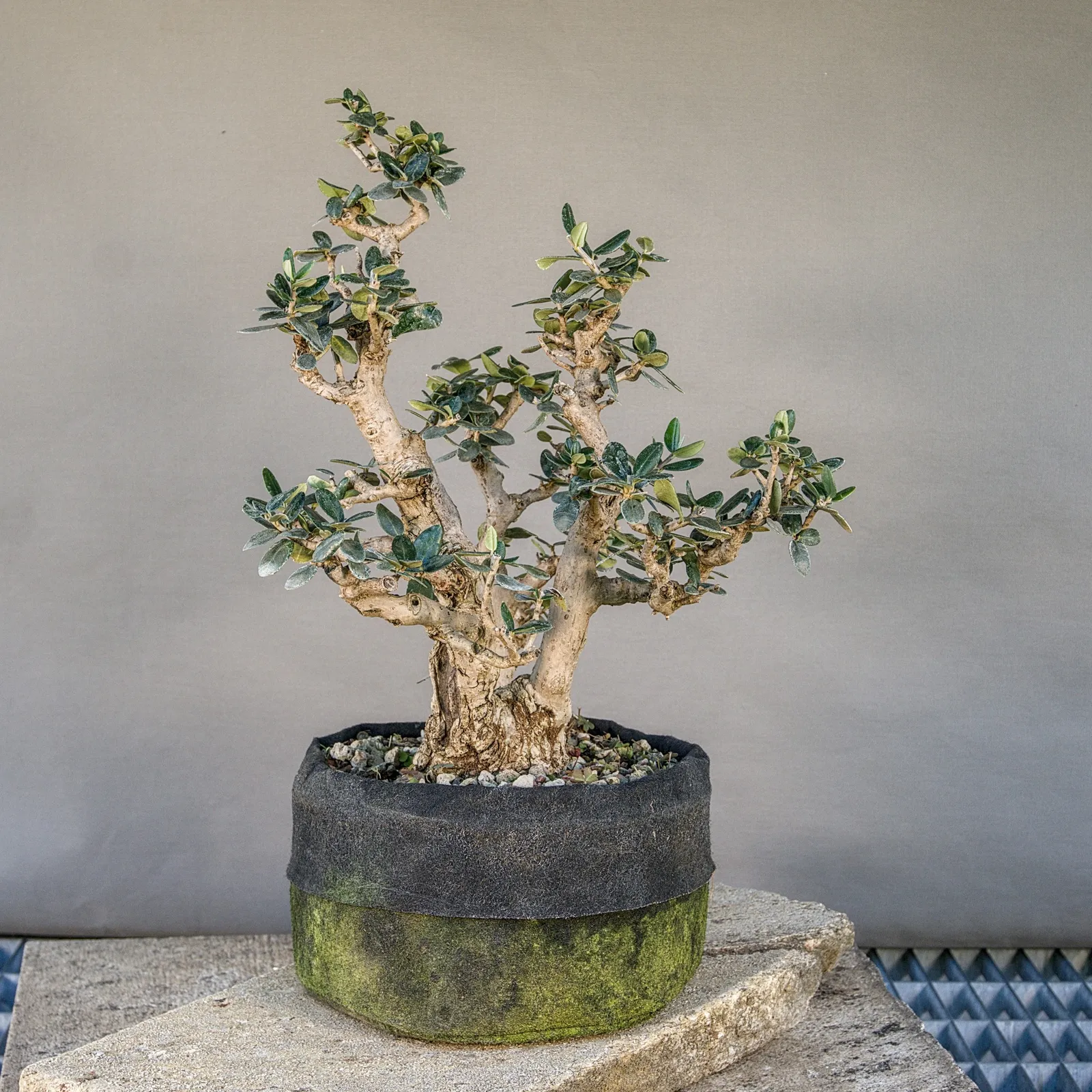
On the thirty-year-old wild olive in this guide the shoots are cut back to the first pair of leaves all summer and none is left to run: the tree is mature and only needs its crown refined, not thickened.
The olive’s nebari: the “step”, and how to correct it
Here is the part the care sheets skip. Many old olives, especially those bought already shaped, carry a flaw at the base that you see at once, once you know it: a step. The base of the trunk is wide and conical, but below it long, thick roots dive straight down, because the tree was planted too high for too long. The result is a trunk that looks perched on a pedestal rather than rooted in the ground.
It can be corrected, with patience. At repotting the thickest vertical roots are removed and the others shortened, keeping every fine root that starts high up, near the base. Then you do the opposite of what feels natural: you bury the nebari by a few centimetres, with a ring of sphagnum pressed against the stumps of the cut roots, because that is the height at which you want the tree to make new roots. For a season the nebari is out of sight. Once the new roots are there, the base is uncovered again and the last low roots are removed, safely.
From the nursery “It has a very beautiful, conical base, but it was planted too high for too long and made roots that are not elegant. We have to remove the vertical roots and get it rooting radially again. Before we have something beautiful to show, the nebari will have to be hidden a little. We sacrifice the look for this year hoping to enjoy it in the years to come.” — Luca, during the wild olive’s repot
The complete job, root by root, is in our post on repotting the wild olive, with the video:
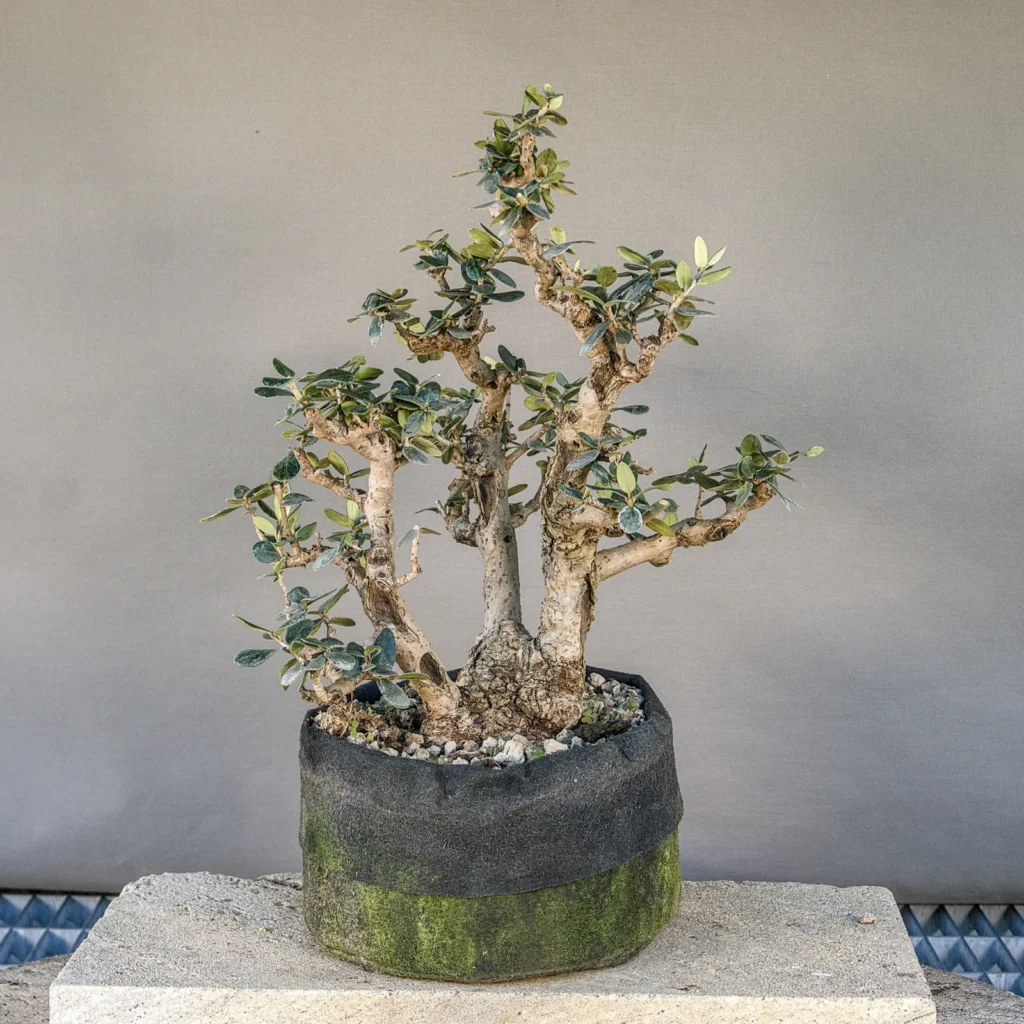
One detail that helps: after that repot the tree went into a fabric pot, not a bonsai pot. The fabric lets the roots breathe and stops them at the edge instead of letting them circle, and it works in the same direction as the sphagnum: fine roots, close to the base. The bonsai pot comes later, when the nebari is ready to be shown.
Why is my olive bonsai dropping leaves?
It is the question we get most often, and in most cases the answer is the room the tree lives in. An olive brought indoors for the winter drops its leaves within weeks: too little light, dry air, warm roots when they should be resting. Put it back outside, somewhere cold and bright, and it buds again in spring.
The other causes, in order: too much water, with soil that never dries and roots that rot; an abrupt move from one environment to another, say from a humid greenhouse into the full sun of May; and normal turnover. The olive is evergreen, but its leaves are not eternal: in spring, as new shoots appear, some of the old leaves yellow and fall. If it is the old ones falling and the shoots are healthy, all is well.
A wild olive in training, from the nursery
The wild olive in this guide is for sale. It is about thirty years old, the last fifteen of them in a pot, with three trunks from a single base and the pale, furrowed bark of an old wild olive. Luca bought it in summer 2024 from the family of the grower who had raised it, reduced it hard and built the branching close to the trunk; the February 2026 repot is the one in the video. It is a mature tree: what it needs now is refinement, not construction.
Olive bonsai (Olea europaea sylvestris), multi-trunk, about 30 years
465 €incl. delivery
In stockIf you would rather start with something smaller, the nursery’s bonsai in training include other outdoor species from €85.
Buying an olive bonsai: what to look at
You do not buy an olive for its height. You buy it for its base and its leaves. Look first at the point where the trunk enters the soil: it should widen, with roots leaving the surface in several directions, not narrow like a bottleneck or show the step described above. Then look at the leaves: small and dense means a wild olive or a tree worked for a long time; large and sparse means a cultivated olive or a tree left to run, which will take years of cutting.
Finally look at the pot. An olive sold in dark, compacted soil that never dries has roots in trouble even if the crown is green: budget for a repot at the first suitable season. And be wary of any olive presented as an “indoor bonsai”: it is the same plant, with a care regime that will kill it.
On price: you pay for years, not centimetres. A two- or three-year-old wild olive seedling costs a few tens of euros and is a ten-year project; a tree with a base already formed, mature bark and its branching set costs hundreds, because those things cannot be bought at an ordinary nursery and cannot be hurried. Between the two lies all the work someone did in your place.
Frequently Asked Questions
Where should I keep an olive bonsai?
Outdoors, in full sun, from March to October. In winter in a cold place sheltered from hard frost: a cold greenhouse, a garage with a window, an unheated stairwell. Never in a heated room.
Can an olive bonsai stay outside in winter?
Yes, as long as the temperature does not fall below about −5 °C for several nights in a row. Below that threshold the roots, which have no protecting soil mass in a pot, are damaged. A cold, bright shelter is enough.
Can I keep an olive bonsai indoors?
No. Indoors there is too little light, the air is dry and the roots never rest. The olive drops its leaves within weeks and dies within a couple of years, often staying green to the end. A sunny balcony is all it needs.
When do you prune an olive bonsai?
New shoots are cut back to the first pair of leaves throughout the growing season, May to September. Structural pruning, removing whole branches or shortening hard, is done in spring, when the tree has the strength to bud back from old wood.
When do you repot an olive bonsai?
Every two to three years, in late spring, once nights are warm. The olive regrows roots in warmth, not in cold. After heavy root work keep it out of wind and direct sun until it starts growing again.
Olive or wild olive: which should I choose for bonsai?
The wild olive. It has smaller leaves, denser branching and bark that twists earlier: everything a thirty-centimetre tree needs. The cultivated olive is used too, but its leaves stay larger.
Does an olive bonsai produce olives?
It can flower and set a few fruits, especially a mature cultivated olive kept in full sun. On a wild olive the fruits are small and rare, and they are usually removed: they take energy away from the ramification being built.